
Tuk the Tuk
I thought I saw an alarming report on the BBC that Sri Lanka is enjoying the benefits of driverless three-wheelers. https://www.bbc.co.uk/travel/article/20250618-drive-your-own-tuk-tuk-in-sri-lanka

Over ten years ago, I published an article on Sri Lankan three-wheelers in the Ceylon Today newspaper. I have drawn here on the research I did for that article.
https://pcolman.wordpress.com/2014/03/16/blessing-or-curse-three-wheelers-in-sri-lanka/
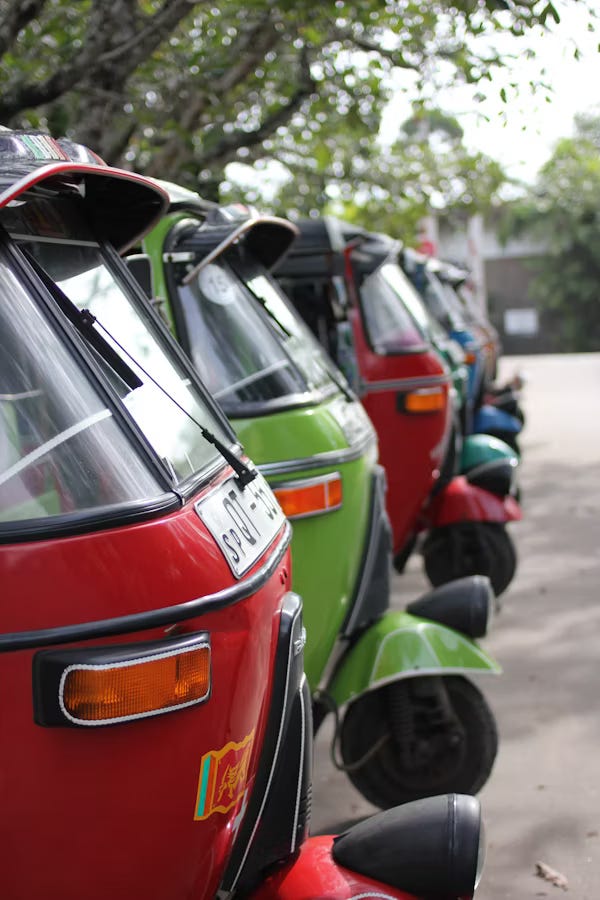
My 23-year stint here has bred complicated feelings about three-wheelers and their drivers. An instant petty thought occurred to me that it would be a good thing to have driverless tuk-tuks if that meant eliminating the drivers. Many of them are villainous and a menace to human life with their anarchic driving styles. Then I thought again and conceded that there may be some good in them. It is usually three-wheeler drivers who are first responders when a hopped-up or catatonically slumbering bus driver flings his vehicle over a precipice.
History of Three-Wheelers
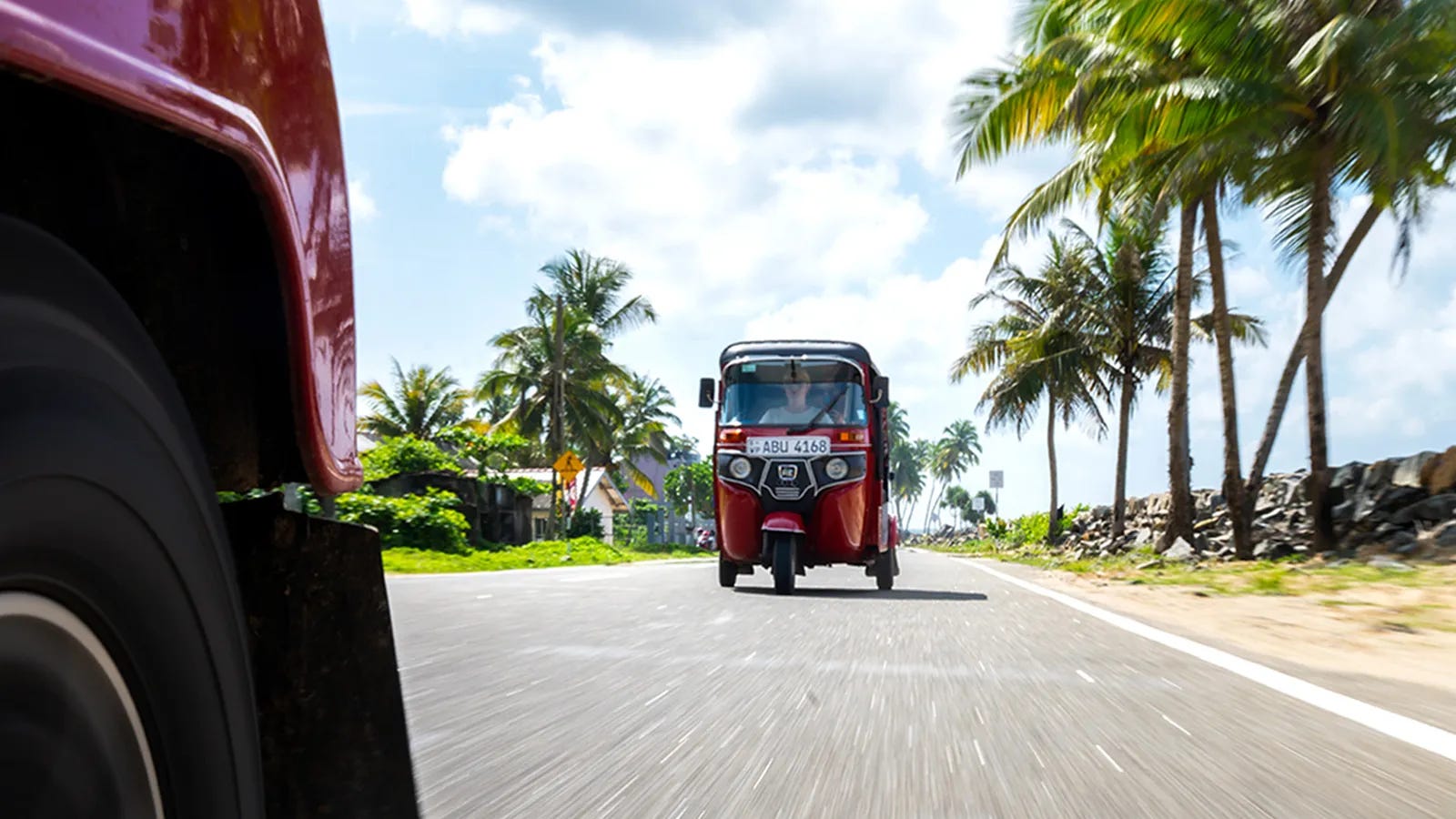
Three-wheeled motorised rickshaws, or tuk-tuks, first emerged in Japan in the 1930s. They were then exported to Southeast Asia, particularly Thailand, where they were modified to suit local needs and preferences. Now they can be seen everywhere – Bangladesh, Egypt, India, Nigeria, Peru, Sri Lanka and Thailand are the biggest markets. They are growing in numbers in cities in east Africa and in Cape Town and Johannesburg, the Middle East and China. In many ways, the three-wheeler (aka auto-rickshaw, samosa, tempo, tuk-tuk, trishaw, auto, rickshaw, autorick, bajaj, rick, mototaxi, baby taxi or lapa) is a wonderful invention. When I lived up in the mountains far from civilisation and booze shops, I found them very useful. I sent for a three-wheeler when I need a new gas cylinder or a crate of beer. Three-wheelers were ideal for negotiating the rocky mountain road to my front gate.
False Alarm
When I read the BBC article more carefully, I discovered that this was not about driverless like the Dockland Light Railway or Autonomous Vehicles “designed to sense their surroundings and operate without human intervention, handling tasks like steering, acceleration, and braking.“ Many three-wheelers with drivers already seem to be operating without human intervention. The BBC is merely reporting that bloody tourists are renting three-wheelers and driving them about Sri Lanka on their own. Yet another menace that we have to endure.
Benefits of Three-Wheelers
When I am in London, I often wish I could flag down a three-wheeler. It is but a short walk to the nearest Lidl (they are everywhere) – too short a distance to trouble a surly Uber taxi driver. However, it is a struggle to get back home laden with heavy shopping bags on one of the excellent London buses. Here in Sri Lanka we have an invaluable asset in Nirmala, a superb three-wheeler driver who is always willing to take us short or long distances and is much better at navigation than us. She is a one-woman Satnav. She knows where all the government offices and utility organisations are. She also runs errands for us and delivers parcels. She knows where to find those little items that hide from us blow-ins.
https://restofworld.org/2021/global-gig-workers-tuktuk-driver-srilanka/
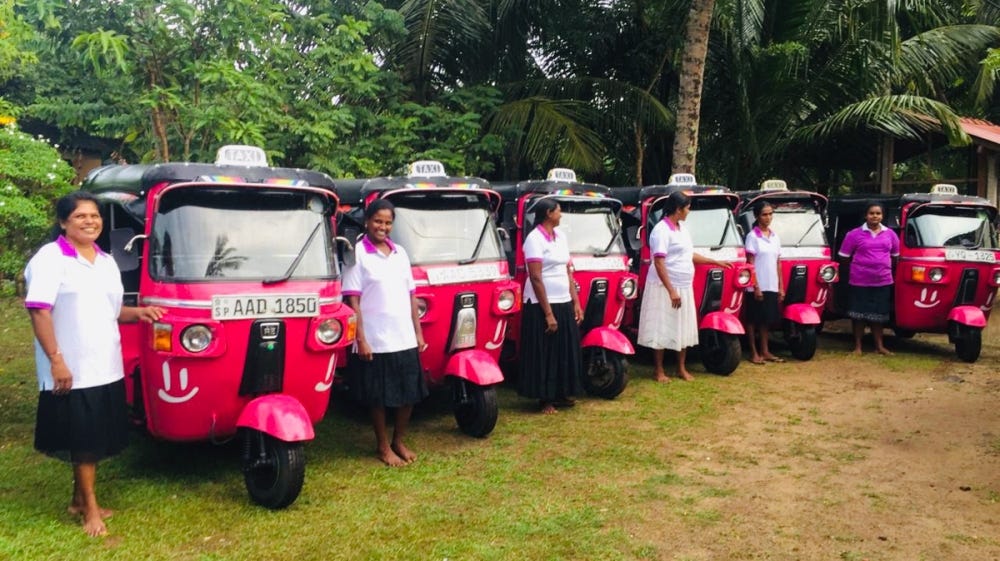
There have been dour and earnest academic papers on the virtues of the three-wheelers. Let me quote from one of them. The authors are AK Somasundaraswaran, MBIT Kumari and DHSDA Siriwardana. They assert that the three-wheeler “provides door-to-door services and helps to reduce the unemployment problem and improve the poverty level”. That is a fair enough argument. Then they get over-excited and partisan on behalf of the three-wheeler. They complain that it is a “pathetic situation” that “their operations fail to get the credit from the society”.
They don’t get credit because of their nuisance value.
Messrs Somasundaraswaran, Kumari and Siriwardana have a somewhat rose-tinted view of Sri Lankan buses too. “In Sri Lanka, after a reformed public transport arrangement in 1977, private sector has taken a key role in providing transport services. Since then the private buses started their operation in a well organized manner with a schedule time table”. What alternative universe are they living in?!
Do they ever go out into the streets? Do they spend all their lives in a darkened room, sheltered from the world of ordinary mortals?
I have written a lot about the malignant consequences of privatisation in the UK. Until now, it had not occurred to me to use the Hammer horror movie example of the privatisation of Sri Lankan buses.
See this about the recent news regarding Sri Lankan buses.
Another Death Bus Crash

Three people were killed and 34 injured when a bus carrying pilgrims went down a precipice after crashing into an electric pole along the Badulla–Mahiyanganaya main road near the Dunhinda Falls on Saturday June 21, 2025. The bus toppled down a precipice at the 4th Mile Post area, near the Dunhinda bends on the Badulla–Mahiyanganaya road.
Our idealistic authors see three-wheelers as filling gaps that even such a well-organised bus service cannot fill. “Transport in early morning or late night has become a problem for the public, especially commuters in rural areas or in small cities. Three-wheelers perform many of the same functions as the taxi and it is considered as a next step up ladder for personal mobility to buses in small cities.”
A Dissenting Voice
The Rajapaksa government tried to encourage the spread of three-wheelers to reduce unemployment (and to win votes). The boosting of three-wheelers by the academics drew an astringent comment from a reader of my article of 2014.
“The initiative aimed at providing employment to people through the enabling of three wheeler ownership is an abject failure. Most of the guys who have bought a vehicle (The vehicles cost £4987 + VAT ) through high interest finance complain that they have little left after the repayments: the dream of becoming a ‘three wheeler entrepreneur’ is an illusionary escape route typically anticipated by many South Asian peoples. It ends up being not dissimilar to cricket watching, just that they sit in three wheelers and gossip most of the day!
They simply don’t have enough ‘work’ to finance hefty loans. The upshot of the ‘unemployed’ drivers is that they get in to vice – Drugs couriering becomes their primary occupation and you would have noticed just as I have, the hundreds sitting near five star hotels that offer ‘massage’. They also transport and sometimes keep prostitutes in their three wheelers, (one driver kept asking me if I was interested in ‘fun’) but in the outstations they cause most of the accidents with multiple fatalities, mainly at railway crossings.”
Downside of Three-Wheelers
I recognise that inconvenience to mygoodself is a trivial matter compared to eliminating poverty in Sri Lanka. I am an early riser, so it was not a major problem to me if I had to set off at sparrowfart do my grocery shopping in Passara. Setting off early was somewhat inconvenient as the booze shops did not open until 9 a.m. If I set off that late, all the parking spaces would be occupied by three-wheelers.
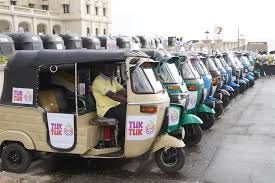
Three-wheelers contribute significantly to traffic congestion. Their sheer numbers increase air pollution. The emissions from these vehicles add to Sri Lanka's carbon footprint, affecting air quality and public health. Emission testing is mandatory but one still sees vehicles belching out black smoke.
Accidents
According to the Sri Lanka Police Department, three-wheelers are involved in a significant proportion of road accidents, because of reckless driving, lack of safety features, and inadequate driver training.
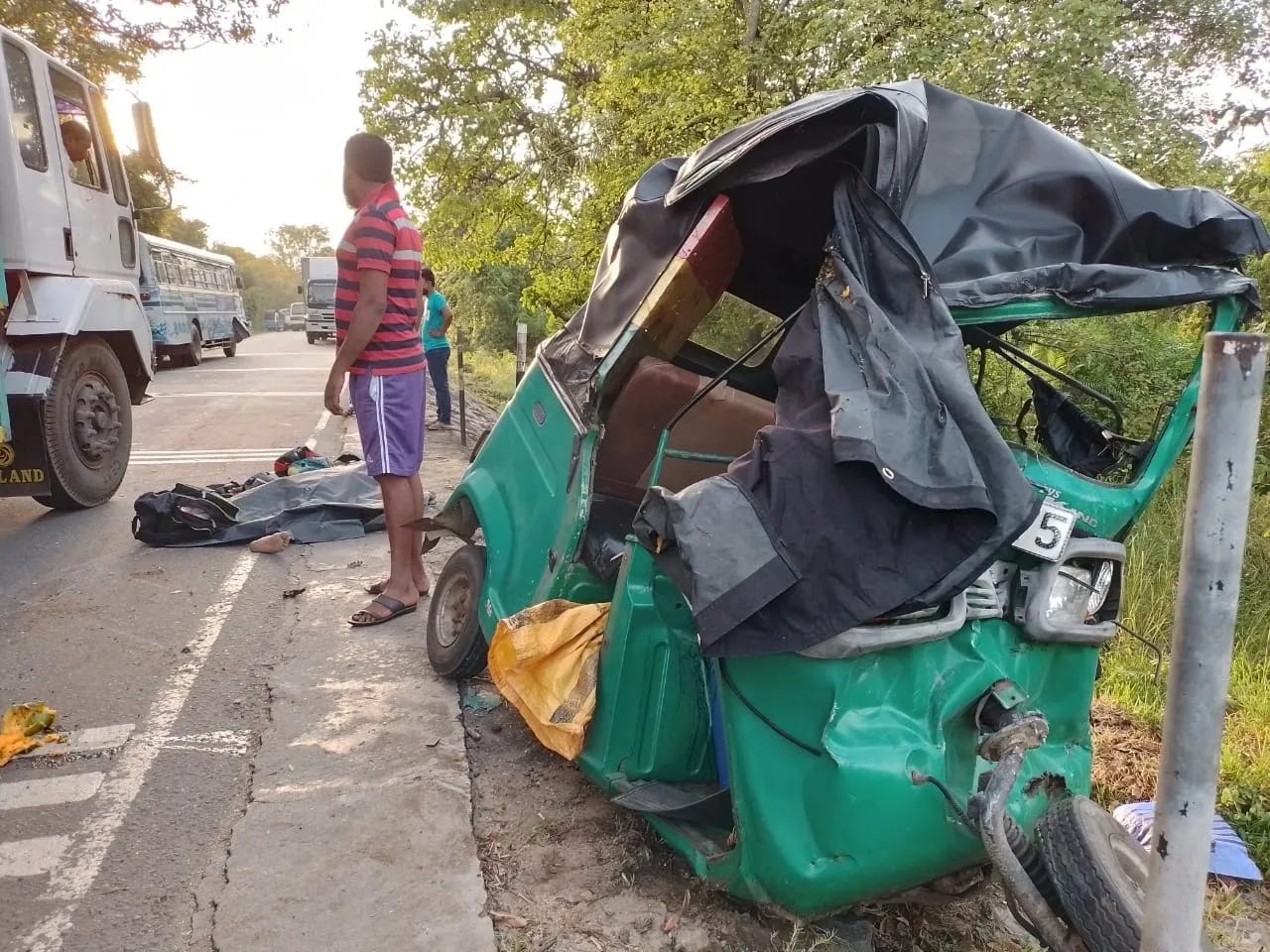
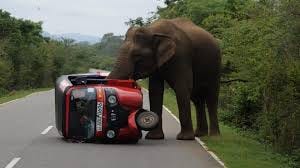
The vehicles are made of lightweight steel and cloth. Their instability and high centre of gravity make them prone to flipping, leading to accidents and injuries, injuring innocent passengers as well as reckless drivers. Nirmala is a capable and prudent driver but her vehicle overturned without warning and she was out of work for a long time with a badly broken leg.
In 2022, there were 3,515 accidents involving three-wheelers, with 285 fatalities. About 15% of fatalities are tuk-tuk passengers. A large percentage of road accident fatalities in Sri Lanka involve pedestrians. There has been a recent increase in serious crashes.
One can easily observe why accidents happen. Three-wheeler drivers are unpredictable. They turn onto the main road at speed without looking. They weave in and out of the traffic. They drive on the pavement. They drive on the wrong side of the road. They drive in the wrong direction. They overtake on the inside. They overtake you on the outside while you are clearly indicating your intention to turn right. They tootle along in the middle of the road with their indicators on, giving a completely erroneous impression of which way they are actually going to turn. Sometimes they are consumed by an irrational urgency, hooting at you the second the traffic light turns to green or when you have left a few inches of road space in front of your vehicle; other times they are in a trance with all the time in the world, hogging the middle of the road.
Meter Men
I had hoped that with the advent of the Nanocab and metered three-wheelers, my transportation around Colombo would be less fraught than in the past. Those tiresome negotiations about fares and grumbles from drivers about distance should have ended. We are not quite transported to that heaven yet. Many years ago, I prebooked a metered Nanocab from the suburbs. We had eaten up quite a lot of the road on the way to our planned destination when the garrulous driver announced: “l forgot to switch the meter on.” I said “Oh.” There was no further conversation.
Metered three-wheelers were great in theory. Initially, it worked well for me in practice. I got in a resting vehicle near House of Fashion and went to Liberty Plaza. The fare was 130 rupees. In the past, I would have had to pay much more, even with prior negotiation. From Liberty Plaza, I accepted an invitation from a driver to get into his “meter cab”. When we got to the Cricket Club Café, he said: “Two hundred rupees.” I asked why his charge was more than for the equivalent or lesser distance in the other direction. “‘What does the meter say?” I naively asked. “Meter broken,” was his riposte.
Saturated Market
In Colombo, there may be enough gullible or intimidated tourists around for the drivers to get away with this and not worry about repeat business. Perhaps some economic law will start to kick in and bad practices will be driven out by good ones. Surely, there is a glut of three-wheelers in the market anyway? Just as there are many more writers of poetry than readers of poetry, there are more three-wheelers than passengers. The market is flooded.
The number of three-wheelers in Sri Lanka has dramatically increased over the past decade. In 2010, the country had approximately 700,000 registered three-wheelers. By 2022, there were over 1.4 million three-wheelers registered across the island.
While the purchase of a three-wheeler might seem affordable at first glance for someone who is not rich, their operation costs can add up over time. Frequent maintenance, fuel expenses, and low fuel efficiency make traditional tuk-tuks a costlier option in the long run. With rising fuel prices and ongoing maintenance requirements, seeking a more economical transportation solution becomes imperative.
The influx of young people into the three-wheeler industry raises concerns about the long-term economic sustainability of this employment trend. Many young drivers face precarious financial situations, with little opportunity for career advancement or skill development outside of driving.