
RS Thomas
I dug up this piece I wrote many years ago. I cannot now remember my sources but I did pass it through a plagiarism checker, so don’t sue me.

I have been stimulated by Alexander Fayne’s article (and the comments) on RS Thomas.

I dug up this piece I wrote many years ago. I cannot now remember my sources but I did pass it through a plagiarism checker, so don’t sue me.
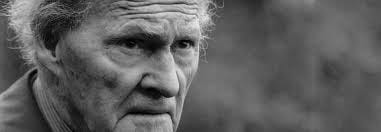
RS Thomas is not an easy man to like. His public image was dour, craggy uncompromising. In his work, he attacked the hypocrisy and delusions of ordinary people and seemed to see it as his mission to force reality upon them. This can come across as misanthropy and misogyny. Do ordinary people need to have their delusions undermined by a miserable God-botherer like Thomas? His stony face and beetling eyebrows might frighten God Himself. He wrote poems in which he accused God of avoiding him, and who could blame Him?
RS (Ronald Stuart) Thomas was born in Cardiff in 1913 and was brought up in Holyhead in north Wales. He died in 2000. He was a poet and a priest. He was ordained in 1937 and worked in rural Welsh parishes - from 1937 to 1940 at Chirk in Denbighshire and subsequently in Tallam Green, Flintshire and Manafon in Montgomeryshire. He retired from the church in 1978 and went to live at Y Rhiw, near Aberdaron.
His breakthrough book of poetry, Song at the Year’s Turning: Poems 1942-54, was published in 1955. John Betjeman wrote the introduction and predicted that Thomas would be remembered long after he, Betjeman, was forgotten. Kingsley Amis said that Thomas’s work ‘reduces most modern verse to footling whimsy’. Amis’s chum Philip Larkin was not a fan, referring to his fellow poet as ‘Arsewipe’ Thomas. Thomas’s early style was straightforward but with surprising images erupting through the plain surface, his content rooted in the landscape, ‘stubborn with beauty’, in which he lived. His later work employed an even simpler style but tended towards allegory and prophecy. He won the Queen’s Medal for Poetry in 1964. He was nominated for the Nobel Prize for Literature in 1996 but Seamus Heaney won. Professor M Wynn Thomas said: “he was the Solzhenitsyn of Wales because he was such a troubler of the Welsh conscience. He was one of the major English language and European poets of the 20th century”.
Many took him as seriously as he took himself, but to me, this dour man presents a somewhat comic, self-parodic aspect. His anti-industrial Welsh nationalism was so inflexible that he could not tolerate telegraph poles, fridges, tractors. He did own a vacuum cleaner but forbade its use because he did not like the noise. He joined the Royal Society for the Protection of Birds but resigned in protest at plans to introduce non-native kites to Wales.
Did he try too hard to be Welsh? Did he protest too much? His Welshness was compromised by his Anglicised background and upbringing (Cardiff may be the capital of Wales but many Welsh regard it as an English city). To draw closer to Welsh-speaking Wales, he moved in 1954 to become vicar of Eglwys-fach, Cardiganshire, and stayed there until 1967, although English settlers were more numerous among his parishioners than Welsh natives.
He disliked bi-lingual Welshmen and was not very fond of the Welsh in general. He did not seem to like anyone very much.
An impotent people,
Sick with inbreeding,
Worrying the carcase of an old song.
AA Gill was excoriated for saying similar things.
Thomas refused to speak English to tourists, but many locals could scarcely understand him when he spoke Welsh to them. When he was at college in Bangor he affected a refined English accent to set himself apart from the other students. He never taught his wife or son Welsh, and sent his son, Gwydion, to an English public school to prevent him spending time with the children of the Welsh ‘peasants’. He fought the influx of holiday caravans but his parishioners would have liked the tourists’ cash.
Thomas had an unusual approach to pastoral duties. Many parishioners remember that he refused to let them in when they visited the vicarage or he hid from them and pretended to be out. The parishioners who did get to see him endured brooding silences.
He was an unsociable man in a job that called for some effort to knit together a community. This is counter-balanced by many stories of an awkward kindness. There is strong evidence that he was a good comforter of the sick, dying and desperate. He was generous with his royalties and encouraged young Welsh poets.
His first wife, Mildred (known as ‘Elsi’), played her part in the silences. She wrote: ‘I adore being alone and Ronald adores being alone, so we decided to be alone together, but felt a bit guilty about being so indulgent.’ In retirement, they lived a needlessly ascetic life. Their cottage was damp and so cold that she did her painting with her feet in a cardboard box. There had been central heating but she didn’t like the look of the radiators. She burnt herself putting an electric fire in the box to warm her feet.
After Elsi’s death, Thomas moved out of their isolated cottage in Y Rhiw and into a house in Pentrefelin, near Criccieth. He began a relationship with Betty Vernon, a former parishioner, a Canadian widow, who met Thomas when he moved to Anglesey in 1994.
An American visitor recalled lunching with the poet in 1994. “On the hearth, a real fire, which Thomas from time to time during drinks poked into warmer life. Betty served Welsh lamb with mint sauce and currant jelly, roasted potatoes with gravy, and the quintessential Welsh vegetable leeks cooked with tomatoes. For afters, there were nods to the non-Welsh: slices of Mediterranean oranges served in a tangy syrup with cream, Brie from France, and Double Gloucester, an English import.”
The dour octogenarian lived cheerfully in sin and queued for lottery tickets at the supermarket. Betty made an honest man of him in 1996 shortly after her previous husband’s death when she and Thomas were both in their 80s. Lee McOwan, who owned the cottage Thomas rented, wrote a memoir in which she confessed she was infatuated with Thomas when he was 81 and she was 45, married with children. She says Thomas enjoyed socialising and the trappings of modern life he had condemned. He liked driving fast. “For a man of 83 he certainly was a fast driver. Our children used to call him ‘RS Turbo’.”
The Country Clergy
I see them working in old rectories
By the sun’s light, by candlelight,
Venerable men, their black cloth
A little dusty, a little green
With holy mildew. And yet their skulls,
Ripening over so many prayers,
Toppled into the same grave
With oafs and yokels. They left no books,
Memorial to their lonely thought
In grey parishes; rather they wrote
On men’s hearts and in their minds
Of young children sublime words
Too soon forgotten.
God in his time
Or out of his time will correct this.
I first came across RS Thomas through a whopping paperback Collected Works of his that I found in Didsbury’s excellent Oxfam. It was in very good nick, and at under two quid, seemed an irresistible purchase, and so he came home with me and took his place on the tiled shelf above the loo.
This shelf housed new books for perusal and consideration while I sat and lingered awhile and contemplated life with three young kids and wondered where was the life that once I led.
It was a staging post for books, and so new arrivals would replace older books, and variety was ever present.
The Collected Works of RS Thomas remained on that shelf for over 15 years until my recent exile into Berlin. And here he sits with me still, though not on a tiled shelf above the loo…well, not yet.
A lovely and informative piece, Michael, so thank you for that, and now I know a little more about him, I’m not surprised I love his poetry so.