
Richard III
Terror in 1955

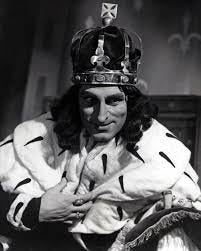
The first play by Shakespeare that I saw was Richard III in Olivier’s film version. From the very beginning, I was terrified. This sinister, ugly, deformed man was talking to me. He was looking at me. He knew where I was in the darkness of the Plaza Cinema, Eastgate Street, Gloucester. He was inviting my complicity in his evil deeds. Worst of all he was charming me and amusing me as well as frightening me. He was evil but he was likable and funny. A predator. He was also, for some reason called Gloucester as well as York and Richard III. The stage directions in the text start the play “Enter Gloucester solus.” I am sitting in the dark in Gloucester. I was born in Gloucester
He tells me personally that he has plans to do bad things:
since I cannot prove a lover,
To entertain these fair well-spoken days
I am determined to prove a villain
And hate the idle pleasures of these days.
He has no illusions about his appearance:
I, that am curtail'd of this fair proportion,
Cheated of feature by dissembling nature,
Deformed, unfinish'd, sent before my time
Into this breathing world, scarce half made up,
And that so lamely and unfashionable
That dogs bark at me as I halt by them.
Even a mother could not love him.
Oh, that deceit should steal such gentle shapes,
And with a virtuous vizard hide foul guile!
He is my son; yea, and therein my shame;
Yet from my dugs he drew not this deceit.
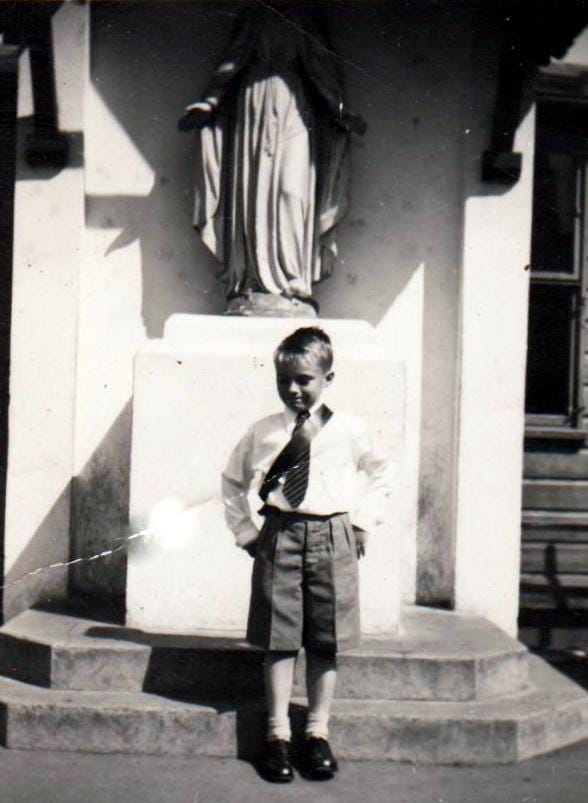
This was 1955. I was nine years old. I was a pupil at St Peter’s junior school, London Road, Gloucester, next to St Peter’s Catholic Church. I had been off school suffering from chickenpox. Although my scalp was still itchy, my father decided that I was sufficiently recovered to be taken to the cinema. I was already something of a cineaste. My Aunty Evelyn often took me to see MGM musicals, such as Singin’ in the Rain, which I saw at the cinema in 1952 when I was six years old.
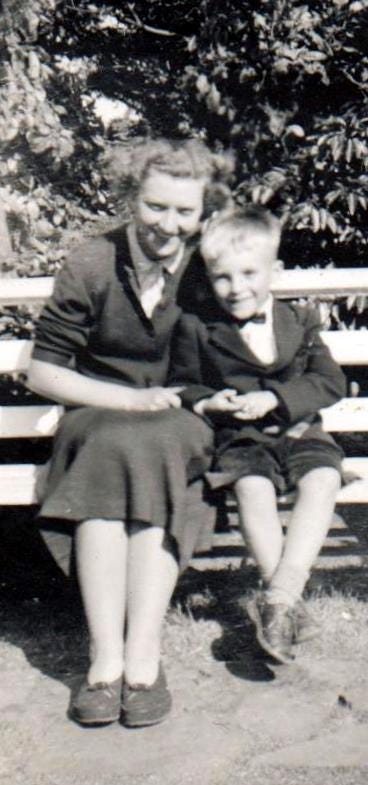
My father went for more serious stuff. He took me to see The Caine Mutiny in 1954. Although he had not had much formal schooling and was employed as a stoker at the gasworks, he was a bit of an intellectual. He was not ashamed to go and see Brigitte Bardot in Et Dieu... créa la femme in 1956 at the Plaza. Also, in 1955 he had taken me to see James Stewart in The Man from Laramie and John Mills in Above us the Waves. He took me to many war films starring John Mills, John Gregson, Richard Todd. When he said we were going to the Plaza I was expecting a war film or a western.
It was quite a shock to this nine-year-old to have this monster, Richard, talking drectly to him. Perhaps today my father would have been accused of child abuse. I tried to hide my terror by pretending to be bored. "Let’s go home Dad. This is boring." My father would not relent and was determined to see it throught to the bitter end at the juncture when Stanley Baker picked up Richard’s crown from a thorn bush after Richard had cried in vain, "A horse, a horse. My kingdom for a horse."
Technicolor is put to great use in the film to capture the brightly hued banners, costumes and crowds.I distracted myself by noticing modern shoe prints on the 15th century floor as blood gushed over it from the beheading of Hastings (Alec Clunes).
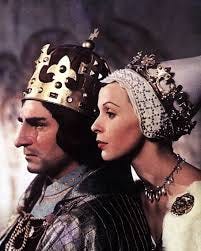
Sitting in the dark on Eastgate Street with an itchy scap, I witnessed many deaths. Richard describes directly to me his plot to marry Lady Anne Neville (Clare Bloom), despite being responsible for the death of her father, Richard Neville, (16th Earl of Warwick), and her husband, Edward of Westminster , the only child of Henry VI and Margaret of Anjou. Anne attends the corpse of the late king, Henry VI and when Richard appears, she berates him and says that "Henry's wounds [...] bleed afresh". Richard confesses to murdering the king, saying Anne’s beauty motivated him. She spits at him. He proclaims his feelings for her and offers his sword for her to kill him, but she drops it. He then offers to kill himself, but she accepts his ring as he promises to repent for the murder. Richard exults at having won her over and tells the audience (that means he tells me personally) that he will discard her once she has served his purpose.I sat through Clarence (John Geilgud) brother of Richard and Edward IV (Cedric Hardwicke), being drowned in a butt of Malmsey. Edward’s Lord Chamberlain, Baron Hastings (Alec Clunes) is despatched. Richard and Buckingham (Ralph Richardson) spread the rumour that Edward's two sons are illegitimate and therefore have no rightful claims to the throne. They are murdered in the Tower. Buckingham defects to the Earl of Richmond but is captured and executed by Richard.
Richard has his eye on the young Elizabeth of York (Helen Haye), Edward IV's next remaining heir, and kills Lady Anne by poison so he can be free to woo Elizabeth.
Soliloquy and Fourth Wall
Although I did not realise this at the time, there were specific technical aspects to my terror. My terror was engineered and manipulated. Shakespeare frequently employed the technique of soliloquy. This was not a dialogue. This horrible but compelling man was expressing his evil thoughts directly at me without the filter of other characters.
In 1955, this nine-year-old had not heard of the concept of the fourth wall. The fourth wall is a theatrical convention, whereby the actors ignore the audience, focus their attention exclusively on the dramatic world on the stage , and remain absorbed in its fiction, in a state that Stanislavski called "public solitude" (the ability to behave as one would in private).
Olivier made a conscious decision to break down the fourth wall and have Richard speak directly to the audience. Directly to me, a frightened nine-year-old.
Richard appears in fourteen out of twenty scenes and speaks 1,000 out of 1,600 lines. Richard is portrayed as a very violent man, but we see none of the violence on stage although we do see murder in the film. The only person who dies on stage is Richard himself. Tony Tanner points out that Richard is bored. “He is elegant, mannered, even fastidious – you will never find a drop of blood on his hands. He just wants something to fully engage his intelligence and energies. He wants his fun, and it’s going to be dark fun.”
I thought the film was never going to end. It did, but it lived on with me. I had nightmares. I walked in my sleep. My dressing gown hanging behind the door transformed into an evil hunchback.
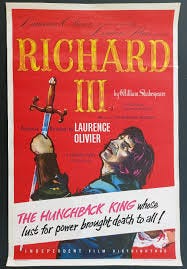
The Olivier Project
Olivier had modelled some of the crookback king's look on a well-known theatrical producer at the time, Jed Harris, whom Olivier called "the most loathsome man I'd ever met". Walt Disney is also said to have used Harris as his basis for the Big Bad Wolf in the film The Three Little Pigs
Olivier worked on his version a long time before bringing it to the screen. His interpretation was first seen at the Old Vic theatre in 1944 and subsequently on a world tour. This is one of Shakespeare’s earliest plays and one of the longest. It can run for four hours and Olivier executed brutal cuts. Margaret of Anjou (Henry VI’s widow) disappears altogether. Passages from other plays were added to clarify the political situation and the structure of the House of York.
It was a good selling ploy for the American market to cast four theatrical knights. One of them did not work for me even when I was nine years old. Edward IV was played by Sir Cedric Hardwicke. There is no point looking for historical accuracy in a work of art, but this casting undermines the work of art itself. The real Edward was a giant of a man (6’’ 4) with blond curls and a reputation as a womaniser. He was only 40 when he died. Hardwicke looks ancient and had huge bags under his eyes. He was 62 when this film was made. Olivier was 5’8’’ but he towers above Hardwicke.
Fake News
In my article on Macbeth, I remarked that Shakespeare was a purveyor of fake news. He was adept at picking up an already distorted narrative from Holinshed or Plutarch and eloquently dragging it further away from the truth. In the case of Macbeth he was aware that the real life Banquo was an ancestor of James I, so he was not going to implicate his monarch in Macbeth’s crimes. He was not going to upset the Tudors, who had usurped and killed Richard, by making Richard the good guy.
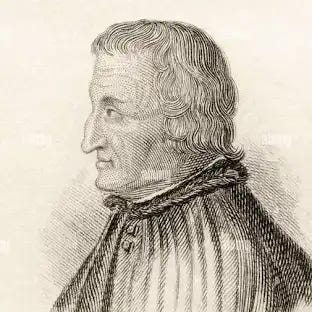
Polydore Vergil was the Tudors’ official propogandist. He openly suggested that Richard rid himself of Anne. He has Richard causing “a rumour…to be spread abroad of the queen his wife’s death…” Vergil’s job was to portray Richard as the epitome of evil and Henry VII (Earl of Richmond) as the saviour of England. Thomas More’s work on Richard also influenced Shakespeare. A charitable interpretation of More’s stance was that it was a humanist warning against tyranny rather than producing propaganda for the Tudors. How humanist was it for More to burn heretics?
The Real Richard?
I enjoyed reading Paul Murray Kendall’s 1955 biography of Richard III. Critics were divided. The Times Literary Supplement wrote: "Brilliantly successful... combines sound scholarship with literary distinction... his descriptions... are always stimulating and sometimes beautiful." Desmond Seward refers to Kendall as Richard III's "romantic apologist."
Kendall paints a portrait of a youthful, competent, loyal servant of his brother the King. “In the space of twelve fierce months, Richard had become the King’s first general, the chief prop of his throne, and his most trusted officer. He was not yet nineteen.” Richard was popular in Yorkshire, offering justice “to all who sought it, were they rich or poor, gentle or simple.” Dominic Mancini wrote in 1482, “The good reputation of his private life and public activities powerfully attracted the esteem of strangers.” “He was a bestower of aid as well as judgement.”
One of the things about Olivier’s film that particularly distressed the nine-year-old me was Richard’s predatory behaviour towards the lovely Clare Bloom (Anne Neville). Real life was somewhat different, according to Paul Murray Kendall. Richard was not an aging unknown monster to the fragile young Anne. They were cousins who had known each other since childhood and were fond of each other. The sixteen-year-old Anne seems to have willingly married the twenty-year-old Richard and they both happily escaped London to live at the castle in Wensleydale “which spelled home to them both”. Richard without quarrel ceded much land and power to Clarence. “If he (Richard) was seeking to marry Anne merely in order to augment his estate, he had made a remarkably poor bargain.” Richard and Anne lived in domestic bliss while Richard set about his job of maintaining order in the North on behalf of his brother the king. In 1473, Anne gave birth to a son. Their domestic happiness was darkened by the treasonous plottings of Richard’s brother, Clarence.
The other brother, George, Duke of Clarence, was a man of hidden shallows, a tergiversator who was constantly plotting against Edward. His good looks and charming eloquence made him dangerous. In Shakespeare’s version Richard plots to undermine Clarence’s standing with the King. In real life, Richard pleads with Edward for Clarence to be forgiven for his greed, ambition and disloyalty.
Shakespeare’s Richard is a Machiavellian agent of chaos. Richard openly acknowledges that he is Vice from the Morality Plays. He is a mischief maker creating evil which seems gratuitous, irrational and unmotivated. The real Richard brought order and justice out of chaos. He rebuilt the North after the anarchy of the Wars of the Roses. There is nothing in Shakespeare about Edward IV being a reasonably popular and pragmatic king reigning for twenty years over a stable and recovering England.
Other Richards
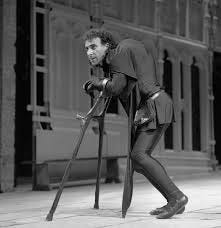
Today, Olivier’s interpretation is considered so definitive that even highly acclaimed performances by the likes of Antony Sher and Ian McKellen (I saw McKellen’s version at the National in 1990. He played Richard as a Nazi.
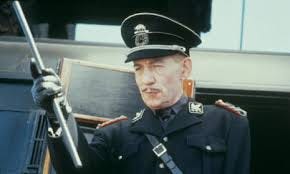
This production, directed by Richard Eyre, formed the basis of a film, directed by Richard Loncraine in 1995.) and Simon Russell Beale are praised as much for their lack of resemblance to Olivier's as for their own intrinsic merit. Even Al Pacino has tried it. Peter Sellers did A Hard Days Night as Olivier/Richard III. On a comeby album Sellers does the soliloquy about capering nimbly in a lady’s chamber as a thespian called J Warrington Minge doing an audition.
David Edgar was my contemporary at Manchester University in the 1960s. He achieved huge success in 1980 with his adaptation of Dickens, The Life and Adventures of Nicholas Nickleby for the Royal Shakespeare Company. In 1974, he wrote a parody of Shakespeare’s Richard III called Dick Deterred. The story is Watergate. Richard is Nixon, a sly, evil Richard, surrounded by machinating courtiers. John Lord Hastings is a corporation lawyer, later Attorney General. H.R. (Bob) Buckingham is an advertising executive, later White House Chief of Staff. Eugene McClarence, duke and Senator from Minnesota, is done in by Richard, Mayor of Chicago.
A Detective Investigates
Richard III reigned for only two years and died at the age of 32. For centuries he was vilified as the hunch-backed wicked uncle, murderer of the princes in the Tower. The Daughter of Time is a 1951 detective novel by Josephine Tey (who was a good friend of John Geilgud who was drowned in a butt of Malmsey in Olivier’s film).
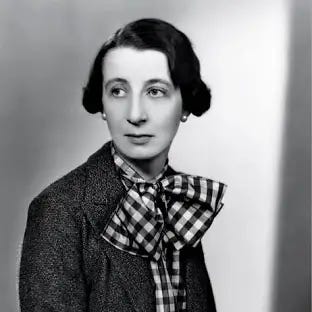
Scotland Yard Inspector Alan Grant is confined to bed with a broken leg. Intrigued by a portrait of Richard III, Grant amuses himself by investigating Richard’s alleged crimes. Using his detective's logic, he comes to the conclusion that the villainy of Richard is a fabrication of Tudor propaganda, as is Shakespeare’s description of him as as a monstrous hunchback. There is a particular focus on the widespread belief that Richard had his brother Edward’s two sons killed in the Tower of London. The mother of the princes, Elizabeth Woodville, remained on genuinely good terms with Richard once he was king, and her daughters regularly took part in social events at his court. There was no political advantage to Richard III in killing the young princes as they presented no threat to him once he was crowned king. The two princes were more of a threat to Henry VII as the foundation of his Tudor claim to the crown was significantly weaker than theirs.
There never was a Bill of Attainder, coroner's inquest, or any other legal proceeding that contemporaneously accused – much less convicted – Richard III of any foul play against the Princes in the Tower. The princes were not reported missing by anyone until after the Battle of Bosworth Field, by which time Richard was dead and the princes were now in Henry VII's custody in the Tower. Grant comes to the conclusion that Henry is a much more likely perpetrator of the dual regicide than Richard when the question of 'who instigated the killing of the princes?' is approached from the traditional crime detection perspective of means, motive and opportunity – particularly motive.
Inspector Grant has a policeman’s healthy lack of respect for professional historians. "That is why historians surprise me. They seem to have no talent for the likeliness of any situation. They see history like a peepshow; with two-dimensional figures against a distant background.'"
"The country was reputedly ringing with the scandal of the boys' disappearance. The very recent scandal. And when his enemies collected his alleged offences against morality and the State they had not included Richard's most spectacular piece of infamy."
Resurrection of Richard
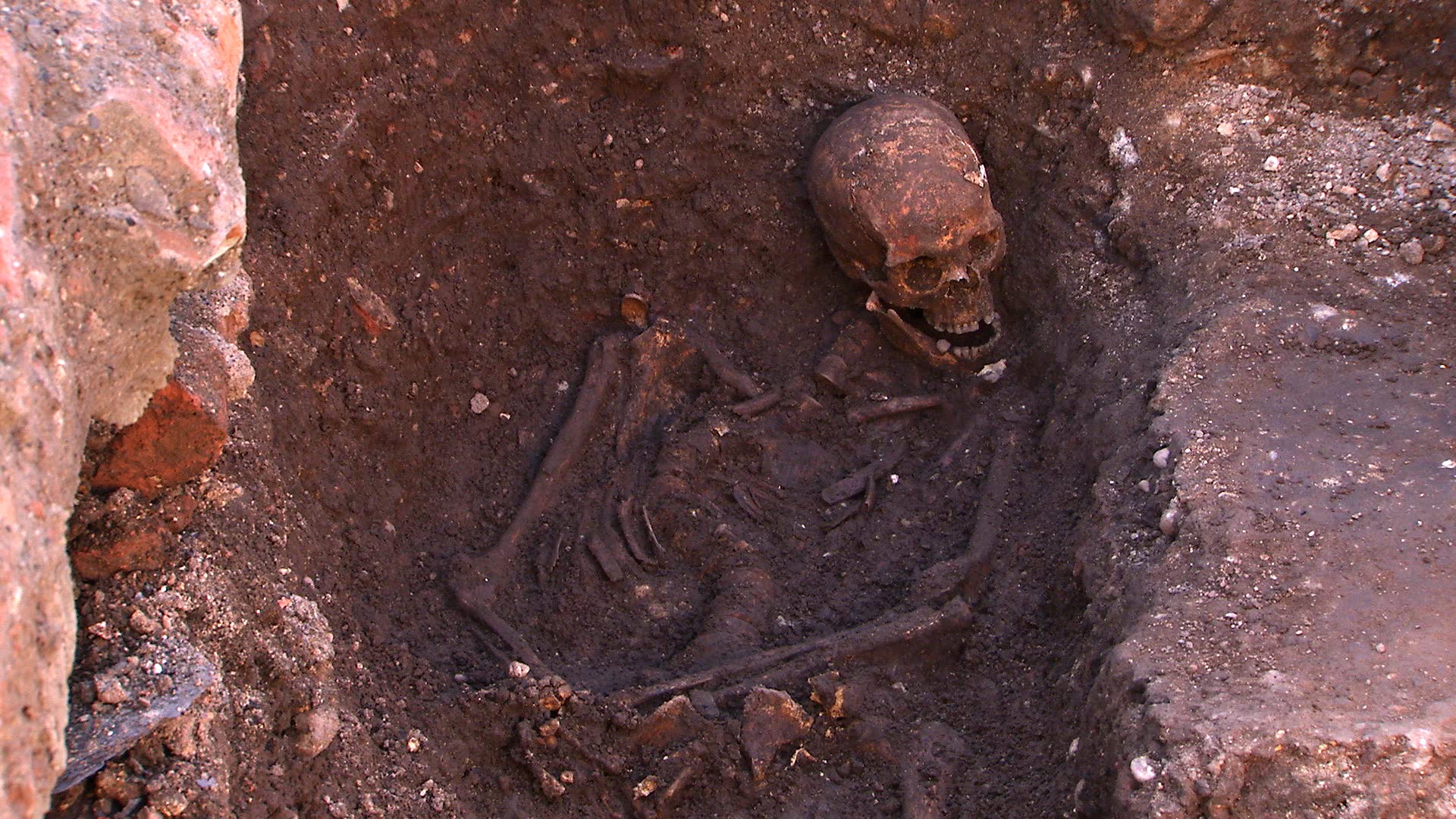
In August 2012, 527 years to the day that King Richard III was killed at the Battle of Bosworth, Leicester City Council, the University of Leicester, and the Richard III Society began the archaeological dig for the ‘Looking for Richard’ project, a search underneath a car park in Leicester, to find King Richard III’s remains and the Grey Friars Church. Experts from the University of Leicester used DNA sampling to link the skeleton to Richard III’s descendants. Carbon dating of the bones dated them to 1455-1540, which coincides with Richard III’s death. Furthermore, the bones were identified to be of a man between late 20s or early 30s and Richard III died aged 32.
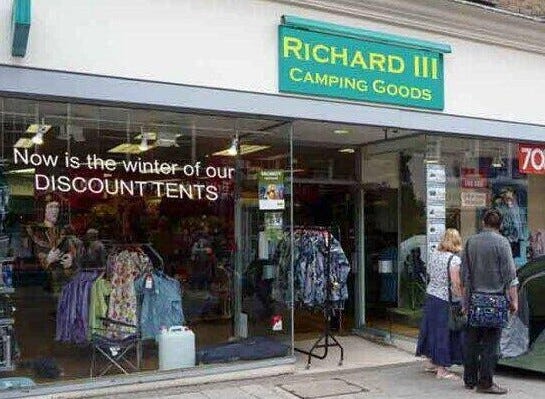
An enterprising retailer of camping equipment launched an advertising campaign using the slogan: “Now is the winter of our discount tents.”
Michael, now we get to know how you got hooked on the bard. My brother in law taught at King’s College in Gloucester and I’ve visited there in my youth so I feel the connection. Your restoration of Richard’s true identity will require me to find the episode on my favorite podcast, the rest is history. If you don’t know it, you may find it amusing as the talkers start off with a Shakespeare quote and then tell the real story.
My American education included a couple of Shakespeare plays, but I never got into them, like you did with R3. I like your reference to the. 4th Wall. I think I’ll steal for one of my stories.