
Remembering about Remembrance Day
I am here expanding on something I published on 11/11/2011 in the Sunday Island newspaper in Sr Lanka.

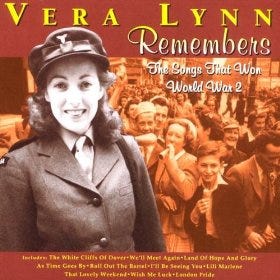
When I was a stroppy teenager, I was profoundly irritated by Poppy Day. A man called Ralph Reader, who had a fake American accent was the epitome for me of the distastefulness of the whole charade of Remembrance Day. On an annual basis, Reader was the Master of Ceremonies of a series of variety shows extolling the greatness of Britain (particularly England). Great prominence was given to sentimental and jingoistic songs sung by old troupers like Vera Lynn who had helped to win the Second World War. My grandparents had a shellac 78rpm record of “There’ll Always Be an England” by the Jack Payne Orchestra. Jack Payne lived on until 1969 and did not appeal to baby boomers. He made occasional appearances on Juke Box Jury and had a radio show on which he castigated contemporary music in a wheezy and lethargic fashion. One can check out his music here.
https://archive.org/search?query=%22jack%20payne%22
Ralph Reader
Reader got started in show business producing shows for the Boy Scout movement and had some success on Broadway.
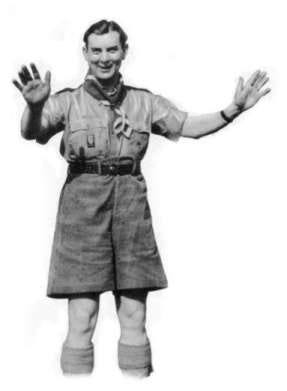
In those days, I thought it somewhat creepy that Reader should identify so intimately with the Scout movement. Scoutmasters were the butt (pun intended) of jokes and the salacious interest of grubby publications like the News of the World. As Geoffrey Wheatcroft put it: “In Evelyn Waugh’s novel Brideshead Revisited, Lord Sebastian Flyte turns the pages of the News of the World and sighs, ‘Another naughty Scoutmaster.’ This was 1923, only a few years after the Boy Scouts had been created, but they had already become a source of indelicate mirth.”
As an elderly person today, perhaps I should be more compassionate. Reader was orphaned by the age of eight, and brought up by aunts and uncles. He joined the Scout movement when he was eleven, maybe seeing it as a surrogate family. He does not seem to have married or had children. As Marty Feldman used to say, “Funny he never married.”
Reader somehow managed to get to New York in 1920. When he was 21, he choreographed his first Broadway show. The New York Times wrote: “Watch Ralph Reader”. He returned to England, where he produced and choreographed variety productions at Drury Lane and the Hippodrome. In 1932, he anonymously staged his first all-Scout variety show at the Scala Theatre, London. (This was in Charlotte Street and not to be confused with the louche repertory cinema - where I spent many happy hours - on Pentonville Road.) The Gang’s All Here featured 150 Boy Scouts, largely from London’s East End, performing sketches, songs and dance numbers.
Theatres of War
The German Ambassador, Joachim von Ribbentrop, attended the 1938 London Gang Show and invited Reader to visit the Hitler Youth Movement in Germany. The diplomatic situation worsened before Reader could take up von Ribbentrop’s invitation. Reader became friends with Air Commodore Archibald Boyle, the deputy director of RAF Intelligence. Boyle persuaded Reader to become an Intelligence Officer in the Royal Air Force Volunteer Reserve with the rank of Flight Lieutenant. Boyle sent Reader to France for undercover work, in the guise of running a concert party, (An inspiration for It Ain’t Half Hot, Mum) for which some former Gang Show members were recruited into the RAF.
Reader eventually raised twenty-four RAF Gang Show units and two female WAAF units, with a total establishment of nearly four hundred serving personnel. The RAF Gang Shows toured nearly every theatre of war, from Iceland to Burma. By 1944, Gang Show units were estimated to have travelled 100,000 miles and entertained 3,500,000 servicemen. Many of Reader’s gang members would later become established stars: Peter Sellers, Tony Hancock, Harry Worth, Dick Emery, Reg Dixon and Cardew Robinson.
Reader was awarded an MBE in 1943.
Poppies and a Threadbare Empire
Reader was no doubt an admirable fellow and I was being terribly unfair to detest him. Call it a clash of generations. We baby boomers had a tendency to arrogance because we had a decent education and the ability to see the tawdriness of post-imperial Britain. The Suez crisis of 1956 is often seen as a significant symbol of Britain’s post-imperial decline, and 1956 was also the year when John Osborne’s play Look Back in Anger was first produced and spawned a movement of “angry young men” disaffected by the state of the nation.
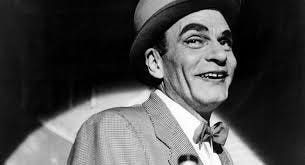
Another play by Osborne, The Entertainer, was produced in 1957. As a child, I was a great fan of variety theatre and old-style comedians. From the age of around five (perhaps earlier) my parents and aunties took me to shows at the Cheltenham Opera House, the Gloucester Regal and various theatres in Brighton and London. The seediness was part of the appeal. I saw Norman Wisdom, Jimmy James, Jewel and Warriss, Arthur English, Old Mother Riley, Dick Emery, Tony Hancock, Dickie Henderson, Ken Platt, Davy Kaye, Hylda Baker, Harry Worth, Roy Castle, Max Bygraves, Billy Danvers, Cyril Fletcher, Billy Dainty, Audrey Jeans, Dave Morris, Max Miller, Max Wall, Jimmy Wheeler, Reg Dixon, Charlie Drake, Morecambe and Wise, Nat Jackley, Ted Ray, Peter Brough and Archie Andrews, Beryl Reid, Jimmy Clitheroe and, last but not least, the brilliant Al Read.
https://pcolman.wordpress.com/2014/05/30/al-read/
In The Observer, Kenneth Tynan reviewed The Entertainer: “Mr Osborne has had the big and brilliant notion of putting the whole of contemporary England onto one and the same stage ... He chooses, as his national microcosm, a family of run-down vaudevillians. Grandad, stately and retired, represents Edwardian graciousness, for which Mr Osborne has a deeply submerged nostalgia. But the key figure is Dad, a fiftyish song-and-dance man reduced to appearing in twice-nightly nude revue.”
In his August 2016 review of a production starring Kenneth Branagh, Henry Hitchings wrote: “As for Osborne’s play, it hasn’t aged all that well, with its flashes of misogyny now pretty hard to stomach. Yet it still has unsettling resonance as a portrait of Britain in decline.”
Decline
Britain’s decline mainly resulted from the bankrupting effort required to beat Nazi Germany. In spite of that, the Attlee Labour government was able to establish a welfare state that saved many from dire poverty, provided health care free for all and enabled working class oiks like myself to get a university education and access to high culture. Successive British governments, including nominally Labour ones, have worked hard to dismantle Attlee’s noble edifice.
Reader’s shows were already an anachronism in the late 50s and early sixties and unfortunately tainted the real meaning of Remembrance Day. They reeked of fly-blown nationalism and imperialism and seemed to me to glorify militarism and war-mongering. One year, I was forced to watch Reader’s show at the house of a schoolfriend by his patriotic parents. They were typical of respectable, conservative, working-class people. Theirs was a very small house but they owned it. By this time, they were surrounded by families from the West Indies. The last time I was in that area, it was full of mosques and burkhas. Even in the 1950s, the Empire had landed on the white working man’s doorstep. Nostalgia for the old Empire became inextricably entwined with racism and resentment, which to me seemed to simmer under the surface of Remembrance Day.
Suffering of Ordinary People
I see Remembrance Day differently now. With maturity, I have developed a better understanding of what my parents’ generation endured to make my life comfortable and secure. My mother worked in an aircraft factory helping to build the Gloster Meteor, the RAF’s first operational jet fighter.
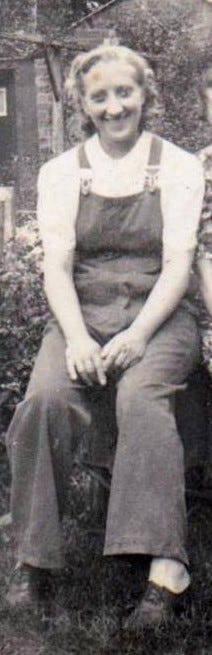
Her younger sister told me about running home from school during a German bombing raid. In 2006, I was at Heathrow Airport on Remembrance Sunday, returning to Sri Lanka.. Waiting for my plane, I heard a call for one-minute’s silence in honour of the fallen. Tears rolled down my cheeks as everyone respectfully observed the silence.
Hypocrisy Survives
When he was UK prime minister, David Cameron arrived in Beijing in November 2010 wearing a Remembrance Day poppy in his buttonhole. The right-wing press heaped praise on him for refusing to remove it when the Chinese asked him to. The poppy had a different symbolism for the Chinese. It stood for a particularly brutal phase of British imperialism, the Opium Wars of the nineteenth century, during which British soldiers killed tens of thousands of Chinese, pillaged, desecrated holy sites, shot prisoners and raped women. All in the interests of Scottish drug-pushers.
Pioneer Corps
My father’s Irish patriotism did not prevent him volunteering for the Pioneer Corps. Michael Young, in The Rise of the Meritocracy, (1958) took an unflattering view of the Pioneer Corps. He claimed that the morale of these “hewers and drawers … these dull-witted men” was spectacularly increased “when the stupid were kept together… and they were no longer daunted by having superior people to compete with”. In fairness to Young, it should be noted that his intent was satirical and his book was a prescient critique of how the cult of IQ measurement would create a dangerously smug ruling class and a profoundly demoralized lower class. That is true today as the British working class has lost its identity and has austerity and insecurity forced on it by rich people who have never done a proper job.
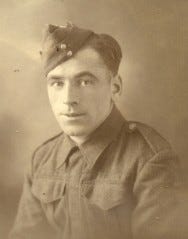
On D-day, 6 June 1944, 13 Pioneer companies landed with the first allied wave and a further ten companies with the second, making a total of about 6,700 men ashore by the end of the day. The first Pioneer party landed 20 minutes after Operation Overlord had started. Some were called upon to provide burial parties, for which they were given special clothing, equipment and transport. The men bivouacked in fields, in unusually bad weather, working extremely long hours with little rest. Owing to the extensive minefields, conditions were dangerous and there were casualties. Over 2,000 British personnel, serving with the Corps, and nearly 6,000 of other nationalities lost their lives.
This was when my father’s sense of smell left him. As well as triggering memories, the sense of smell has served us well as a warning of danger, for example the smell of gas, smoke suggesting that we need to take action to prevent harm by fire. The last thing my father remembered smelling was rotting corpses on the Normandy beaches. My father had no obvious wounds from the war but his anosmia was a real disability. Did D Day teach my father the flimsiness of the flesh, how fine is the mesh that binds muscle to bone, how temporary the breath? Despite his wit and humour, he lived, I now realize, with an unrelenting tinnitus of anxiety until his death. He died of cancer at the age of 56. He had no debts, but only six hundred pounds in the bank. There was insurance to pay for the funeral.
He was not complicit in the malignant forces of ideologies and systems of terror that crushed common people and swept them away. The great tides of history, of isms and empires buffet little people, hurt them, maim them, kill them, uproot them and inflict damage that lasts for years or generations. Today, in Ukraine the guiltless suffer from the delusions of the mighty.
We must contemplate the dangers of forgetting and also the dangers of remembering. Ernest Renan wrote that nationhood requires forgetting many things. He cited the massacre of Huguenots on St Bartholomew’s Day as a symbol of the kind of thing France needed to forget in order to be a nation. Jorge Luis Borges, in his short story Funes, the Memorious, describes a young man who, as a result of a riding accident, has lost his ability to forget. Funes has a tremendous memory, but he is so lost in the details of everything he knows that he is unable to convert the information into knowledge and unable, as a result, to grow in wisdom. Stephen Dedalus, in James Joyce’s Ulysses, said that history was a nightmare from which he was trying to awake.
There comes a time when truth and reconciliation has to take the place of endlessly rehearsing grievances from centuries back, as the Irish were prone to do. Sectarian killings in Northern Ireland sporadically continued long after the IRA gave up their arms. Belatedly, loyalist paramilitaries announced that they had renounced violence (tell that to the Roma that they terrorised into leaving Ireland). There are still riots as one tribe or another remembers its grievances.
This was fascinating to read especially as an American. I knew nothing of Mr Reader nor the Scout shows. Any chance you ever saw George Formby or Flanagan & Allen? You may have been too young.
My problem with Remembrance Day is that, consciously or otherwise, it focuses on the wrong thing to remember. Instead of focusing on the evils of war, we choose to commemorate the vainglorious pride of victory; victories that came about because of the largely useless and pointless, not to mention merciless, deaths of millions of innocent people.
I once performed in a Gang Show in Manchester…back when we were innocent and, thankfully, ignorant of owt else! Ha-ha!
Lovely piece, Michael!