
Other Macbeths
Macbeths I have preferred to Ralph Fiennes

John McWilliams commented on my article about Ralph Fiennes’s Macbeth (directed by Simon Godwin) that I obviously hated the play on the stage so much that I should stick to reading a text.
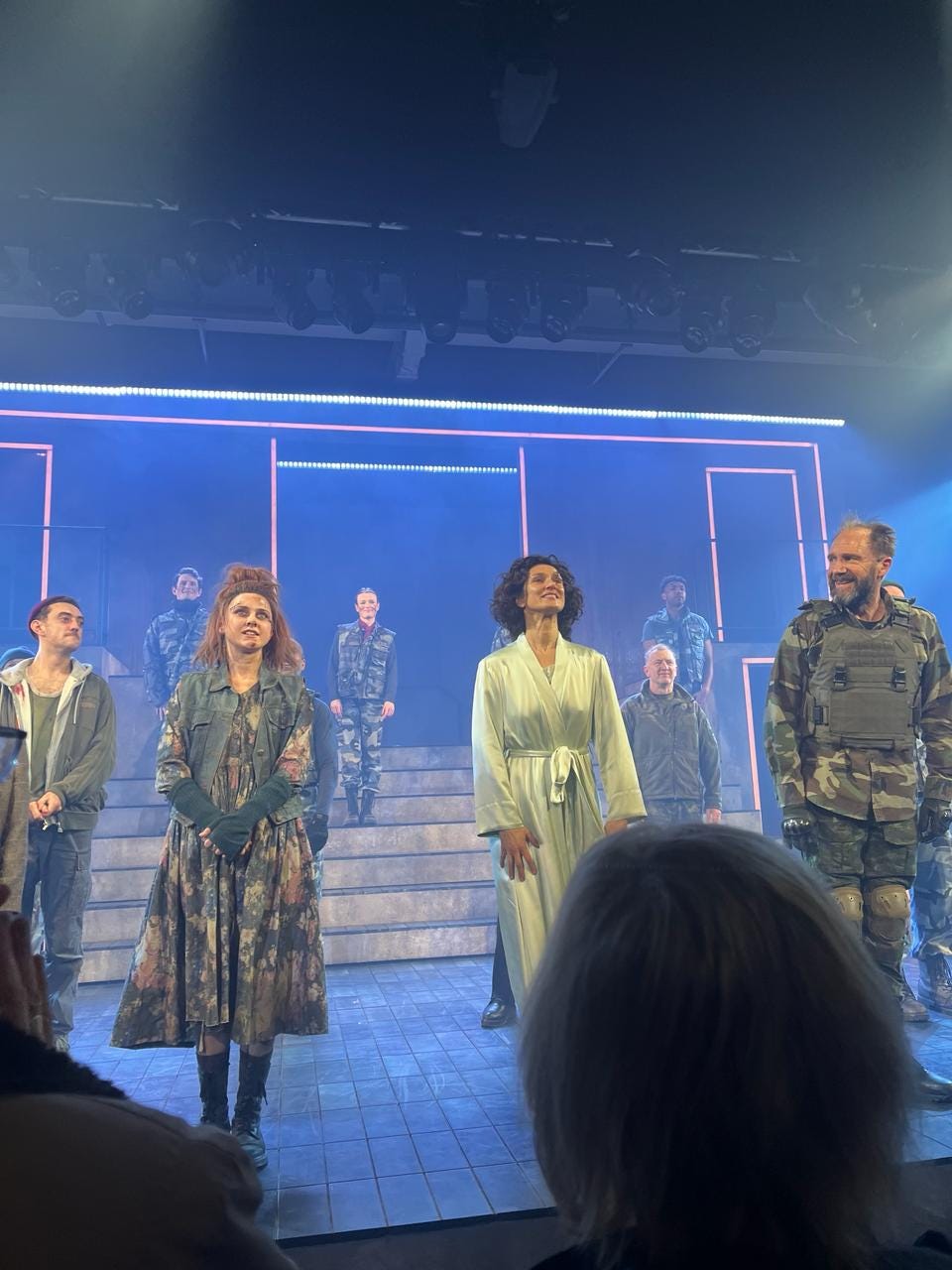
That, John, with respect, was a misinterpretation of my position. My point was that I have seen many versions of the play that I have liked more than this one. The play has been done so many times over the course of four centuries plus that directors feel a compulsion to do something different. Fair play to them. Some approach this in good faith, some resort to irritating gimmicks. I am interested in the words and prefer interpretations that let the words do the work. This does not mean that I am averse to stage productions or films that try an innovative approach.
Orson Welles
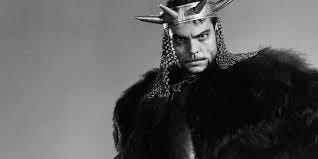
Welles’s 1948 version takes place in a bleak wet landscape with Macbeth garbed like Genghis Khan and many of the other characters dressed like Trump’s January 6 insurrectionists. Welles opts for variations of Celtic accents with a few characters sounding like characters out of Whisky Galore or Hamish Macbeth. The music is by French composer Jacques Ibert, whose 1935 Concertino da camera for alto saxophone and eleven instruments I used to listen to a lot. Macduff is the distinguished Irish actor Dan O’Herlihy. Welles worked with a lot of Irish actors at the Gate Theatre, Dublin. O’Herlihy claims to have used a Cork accent for Halloween III. Jeanette Nolan was Lady Macbeth. She later played a lot of witches on TV and provided the screams for Hitchcock’s Psycho. Some fine screaming here in her first film role. Malcolm was Roddy McDowell (Born in England of Irish parents.) The film was produced at Republic Studios, a "Poverty Row" studio in Hollywood. The sets were leftovers from other productions, and the costumes and props were leftovers as well.
Crypt production
One of the most impressive productions was one I saw at Crypt Grammar School in Gloucester in 1963. I saw a number of excellent Shakespeare productions at that school. One that particularly sticks in my mind is Richard II. The productions were not in modern dress but were in the contemporary style pioneered by the Royal Shakespeare Company at the Memorial Theatre at Stratford and the Aldwych in London with directors like Peter Brook, Trevor Nunn and Peter Hall. The Crypt director was Charles Lepper who joined the staff of Crypt school in 1954 as an English teacher. For the previous five years he had been a professional Shakespearean actor but his career was cut short when he started to lose his hearing (a bonus when dealing with raucous schoolboys). Under his direction, the school staged an annual performance of a Shakespeare play to great acclaim. He died at the age of 92 in 2015.
Polanski
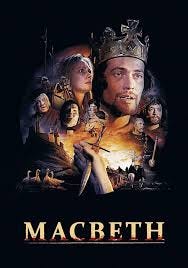
Roger Ebert wrote about Polanski’s (and Kenneth Tynan’s) Macbeth: “They seem so ignorant at times that you wonder if they understand the wonderful dialogue Shakespeare has written for them. It's as if the play has been inhabited by Hell's Angels who are quick studies.” The movie was Polanski’s first after the Manson Family butchered his pregnant wife. High stakes here compared to the Underbelly production. There are elements of Monty Python from time to time. Terence Bayler, who played Macduff, was a frequent collaborator with the Pythons. Interesting that Lady Macbeth was played by Francesca Annis who lived with Ralph Fiennes for eleven years. She also lived with this Macbeth, Jon Finch, for four years. The assistant executive producer was Bob Dylan’s father-in-law, Victor Lowndes, and the executive producer was Playboy head honcho Hugh Hefner. There is a scene where the weird sisters have multiplied and are naked. This is like a geriatric version of the cover of Hendrix’s Electric Ladyland rather than a Playboy centerfold.
Trevor Nunn
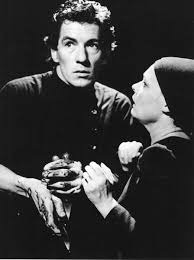
I recall Ian McKellen’s look in 1979 being more menacing and timeless than the suburban middle manager weekending in the Territorial Army we saw in the Fiennes version. Trevor Nunn’s 1976 RSC production was transferred to TV by Philip Casson in 1979 and used film to great advantage, adding layers of atmosphere (a lot of fog and darkness) in its simple and effective studio setting. Apparently, all the props only cost £250. Minimalism creates claustrophobia and lets the words do their work. There is no attempt at realism or modern relevance but the words are clearly spoken and the plot is easy to follow. The performances by Ian McKellen, Judi Dench, John Woodvine, Bob Peck, Ian MacDiarmid and Duncan Preston (even though he was a funny man on the Victoria Wood show) are authoritative and not at all silly (although Roger Rees as Malcolm was burdened with a Clancy Brothers Aran knit pullover). The austerity of the production gives it a maturity and timelessness that other versions which pursue wokeness or “relevance” lack.
Kurosawa
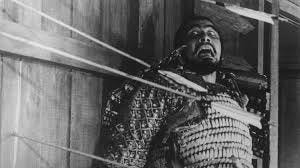
Guardian film critic Peter Bradshaw writes of Kurosawa’s Throne of Blood: “Despite having none of Shakespeare's language at his disposal, Kurosawa brings off the remarkable trick of projecting the spirit of the poetry out onto the landscape and into the faces of his principals. An authentic classic.” Taking the strict formality and stylized action of the Japanese Noh drama as a starting point, Kurosawa crafts a series of incredible sequences, full of striking contrasts.
Justin Kurzel
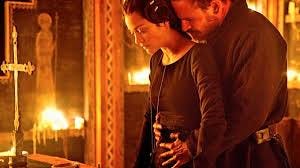
Justin Kurzel’s 2015 film version starring Michael Fassbender and Marion Cotillard has the characters (even the king and the nobles) dressed like the homeless men in Thornton Heath inhabiting a brutal landscape that looks more like the Gobi Desert than the Scotland and Surrey where it was actually filmed.
Joel Coen
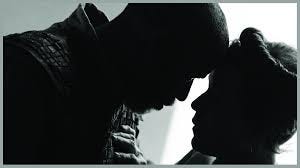
Strong and serious central performances from Denzel Washington and Frances McDormand. Critic Odie Henderson wrote that this “Macbeth” is as much about mood as it is about verse. Most of the actors speak the verse clearly and the director, Joel Coen, gets good facial expressions and natural body movements from the actors (although both Macbeth and Macduff affect a strange bandy-legged gait).
The photography is striking and the use of closeup is very effective. Some have compared the effect to that of film noir. The music by Carter Burwell is excellent. A lot has been cut from the text in order to make it more direct, although the porter scene, which is cut in the Fiennes production, is indulged to give a comic turn to Coen Brothers stalwart Stephen Root. One weird sister, Kathryn Hunter, covers for three. Mrs Macbeth is Mrs Coen. The first time I saw Frances McDormand on screen she was a heavily pregnant cop battling the snowy wastes in Fargo. Odd then to hear her uttering the lines:
"Unsex me here
And fill me, from the crown to the toe, top-full
Of direst cruelty: make thick my blood,
Stop up th’accèss and passage to remorse,
That no compunctious visitings of nature
Shake my fell purpose, nor keep peace between Th’effect and it.
That no compunctious visitings of nature
Shake my fell purpose, nor keep peace between
Th’effect and it. Come to my woman’s breasts,
And take my milk for gall, you murth’ring ministers."
She would go down well on MumsNet.
Tony Tanner
When I was a mere slip of a thing, Tony Tanner was one of my heroes and had an influence on my life. He did brilliant work on English literature at Kings College, Cambridge, but was also a pioneer on behalf of American literature in England. I opted to do a degree in American Studies partly because of Tanner’s writing. There was a joke at the time: “What are you studying at University?” “American literature.” “Oh? And what do you do in the afternoon?”
My favourite book on the Bard is Tanner’s Prefaces to Shakespeare. I have to be careful not to drop it my foot. It is a massive tome, but top quality all through.
AS I said above, some have noticed the influence of film noir on Coen’s version. In his Preface to Macbeth, Tanner goes right to the heart of darkness in the text of the play.
Stars, hide your fires.
Let not light see my black and deep desires.
The eye wink at the hand; yet let that be,
Which the eye fears, when it is done, to see.
And:
There’s husbandry in heaven.
Their candles are all out.
There are no stars to guide because the gods are being frugal with their candles.
Thou seest the heavens, as troubled with man’s act,
Threatens his bloody stage: by th’clock ’tis day,
And yet dark night strangles the travelling lamp:
Is’t night’s predominance, or the day’s shame,
That darkness does the face of earth entomb,
When living light should kiss it?
And more:
Come, thick night,
And pall thee in the dunnest smoke of Hell,
That my keen knife see not the wound it makes,
Nor Heaven peep through the blanket of the dark
To cry ‘Hold, hold’!"
Willy certainly had a way with words!
Light thickens, and the crow
Makes wing to th’rooky wood;
Good things of day begin to droop and drowse,
Whiles night’s black agents to their preys do rouse.
Thickness, in the sense of viscosity, is something that comes up frequently. Light is thick. Blood is thicker.
Make thick my blood,
Stop up th’accèss and passage to remorse,
That no compunctious visitings of nature
Shake my fell purpose, nor keep peace between
Th’effect and it.
Blood is mentioned over 100 times in the course of the play
There is a lot of violent imagery connected with childbirth. Macduff is ripped from his mother’s womb.
This have I thought good to deliver thee (my dearest partner of greatness), that thou mightst not lose the dues of rejoicing by being ignorant of what greatness is promised thee.
Lady Macbeth refers to a child:
I have given suck
Tanner notes that Macbeth is a very short play (occupying only 21 Folio pages compared the Hamlet’s 31) and speedy. As Tanner puts it, “Hamlet is, effectively, one long pause, and it is very long.” Whereas the Dane mopes around for hours trying to avoid action (see you later, procrastinator) these Jock lads rush around getting things done, administering Gorbals kisses, lopping off heads, murdering kings, slaughtering children and generally splitting fellows from the nave to the chaps. No messing, Jimmy! Apparently, the real Macbeth reigned successfully for 17 years after killing Duncan who was a young and unsatisfactory ruler (nothing like Brendan Gleeson). “Shakespeare collapses those years into what must be a matter of weeks (‘haste’) and makes Duncan old and venerable (thus the deeper the damnation of his ‘taking off’).
There is a lot of fake news in Shakespeare as well as universal truths.
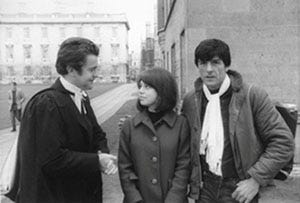
The picture here shows Tony Tanner on the left in a gown (looking rather like the actor Tom Hollander) with his future wife Marcia Albright and poet Thom Gunn.
Just back from seeing Tennant’s version. Thoroughly enjoyed it and not too gimmicky. An excellent Lady Macbeth. Not a peep or mobile phone ping throughout. The sound quality was excellent, as was Tennant’s diction. “Life is a tale / Told by an idiot, full of sound and fury, / Signifying nothing” brought a tear to the eye. Only issue I had was with a well-endowed lady playing a male soldier. I found her assets distracting.