
How To Write
Advice from The Poor Mouth (An Béal Bocht)

I am forever fulminating against the unsought advice on how to write given out on Substack by mere novices and semi-literate children. I am so jaded about the whole malarkey that I am going to give the writing advice business a bit of a shot meself.
Here goes:
There are some words that you can well manage without ever using. Never use the following words because ye will probably get them wrong and make an eejit of yerself:
Literally
Decimated (when you mean slightly depressed)
Depressed
Disinterested (when you mean uninterested)
Multiple (when you mean many)
Super (when you mean very)
Very
Awesome (when you mean quite nice)
Nice
Hopefully
Infamous
Enormity
Refute
Jejune
Crescendo
There will be plenty (multiple) more irritating excrescences to come but I need to have a lie down (not a lay down, mark you.)
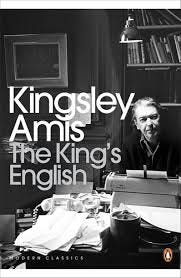
As Amis fils comments in his foreword to his father Kingsley Amis’s entertaining book The King’s English, “A supposedly smart addition to the language becomes an inadvertent subtraction.” Martin Amis uses the phrase, “maladies of the herd.” There are herd words and herd phrases. Martin Amis uses as examples, no-brainer and past its sell by date, but there are new ones coming along all the time. I have noticed optics, learnings and many more.
Kingsley writes this with tongue somewhat in cheek (see below for Catechism of Cliché): “Resistance to all linguistic change is obviously a healthy instinct…”
Your writing will be better…
Be specific – concrete rather than abstract, precise rather than vague, name that particular flower, rather than saying “flowers”.
William Carlos Williams wrote: “no ideas but in things.”

Henry Watson Fowler wrote: “abstractitis. The effect of this disease, now endemic on both sides of the Atlantic, is to make the patient write such sentences as Participation by the men in control of the industry is non-existent instead of The men have no part in the control of the industry … The danger is that, once the disease gets a hold, it sets up a chain reaction. A writer uses abstract words because his thoughts are cloudy; the habit of using them clouds his thoughts further; he may end by concealing his meaning not only from his readers but also from himself, and writing such sentences as The actualization of the motivation of the forces must to a great extent be a matter of personal angularity …”
When I was editing papers for an NGO, I encountered the following: “The building was located in close proximity to the commercial and cultural capital of Columbo.” I translated this to: “It was near Colombo.”
I enjoy the prolix and the digressive at times, but you can get away with that class of a thing if you are a genius like Marcel Proust, James Joyce, Laurence Sterne or Anthony Burgess or an eccentric like Robert Burton. Mere hacks like Camus and Hemingway sought safety in lucidity and brevity.
Aristotle: “Style to be good must be clear. Clearness is secured by using words that are current and ordinary.” He might have been a bugger for the bottle, but he had some good ideas.
Read a lot and steal a lot. Stealing other people’s work develops your editing skills as you strive to avoid charges of plagiarism. In his 1920 essay ‘Philip Massinger’, TS Eliot writes: “Immature poets imitate; mature poets steal; bad poets deface what they take, and good poets make it into something better, or at least something different.”
Ezra Pound wrote: “make it new” (a rendering (plagiarising?) of a passage in Da Xue, a historical Chinese text.)

George Orwell wrote that much English prose “consists less and less of words chosen for the sake of their meaning, and more and more of phrases tacked together like the sections of a prefabricated henhouse.”
For Orwell, what he saw as the decline of the English language, was a political matter: “A man may take to drink because he feels himself to be a failure and then fail all the more completely because he drinks. It is rather the same thing that is happening to the English language. It becomes ugly and inaccurate because our thoughts are foolish, but the slovenliness of our language makes it easier for us to have foolish thoughts. “

I do not know why Brian O’Nolan took to drink. He had many foolish thoughts which made many people laugh. He despised cliché as much as Orwell did.
Brian O’Nolan was a morose drunk who led an uneventful life as a senior civil servant in Dublin. He showed initial promise in that career but the drink gradually sapped his enthusiasm. His real name was Brian Ó Nuallán. Under various aliases (he has been called a “serial pseudonymist”) – Flann O’Brien, Myles na gCopaleen, Count O’Blather, George Knowall, Peter the Painter, Brother Barnabus, John James Doe, Winnie Wedge, An Broc (The Badger) – this disappointed and rather sad man wrote some the funniest prose ever to appear in print. For clarity’s sake I will refer to him as Flann O’Brien.
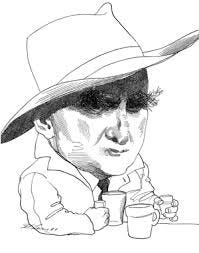
A series of erudite articles about him was written by megoodself (using a pseudonym).
https://pcolman.wordpress.com/2013/09/30/flann-obrien-and-catholicism/
“The Myles na gCopaleen Catechism of Cliché. In 356 tri-weekly parts. A unique compendium of all that is nauseating in contemporary writing. Compiled without regard to expense or the feelings of the public. A harrowing survey of sub-literature and all that is pseudo, mal-dicted and calloused in the underworld of print. Given free with the Irish Times. Must not be sold separately or exported without a license. Copyright, printed on re-pulped sutmonger's aprons. Irish labour, Irish ink. Part one. Section one. Let her out, Mike! Lights! O.K., Sullivan, let her ride!”
O’Brien showed a morbid sensitivity to the ossified language of bureaucracy which he encountered every day of his working life. In his Cruiskeen Lawn column for the Irish Times (under the pseudonym of Myles na gCopaleen) he exposed mortified language to a cold stare, with occasional pieces under the heading of Catechism of Cliché.
What happens to blows at a council meeting?
It looks as if they might be exchanged!
What does pandemonium do?
It breaks loose,
Describe its subsequent dominion,
It reigns.
How are allegations dealt with?
Hotly.
What is the mean temperature of an altercation, therefore?
Heated.
What is the behaviour of a heated altercation?
It follows.
What happens to order?
It is restored.
Alternatively, in what does the meeting break up?
Disorder.
What does the meeting do in disorder?
Breaks up,
In what direction does the meeting break in disorder?
Up!
In what direction should I shut?
Up
*************************************************************************************
Is treatment, particularly bad treatment, ever given to a person?
No. It is always meted out.
Is anything else ever meted out?
No. The only thing that is ever meted out is treatment.
And what does the meting out of treatment evoke?
The strongest protest against the treatment meted out.
************************************************************************************
In what can no man tell the future has for us?
A Store.
What is comment?
Superfluous.
How does one proceed to add?
Hasten.
What is certain?
One thing at least.
In what do they indulge?
Flights of oratory.
In what way must a problem be confronted?
Head on.
What, as to the quality of solidity, imperviousness, and firmness, are facts?
Hard.
And as to temperature?
Cold.
To what do hard facts belong?
The situation.
And to what does a cold fact belong?
The matter.
What must we do to the hard facts of the situation?
Face up to the hard facts of the situation.
What does a cold fact frequently still do?
Remain.
And what is notoriously useless as a means of altering the hard facts of the situation?
All the talk in the world.
You can have some fun with cliches like Dylan Thomas did by twisting them and making them new. Myles did this with his characters Keats and Chapman who were the orifices for the most excruciating puns. “Keats and Chapman once climbed Vesuvius and stood looking down into the volcano, watching the bubbling lava and considering the terile ebullience of the stony entrails of the earth. Chapman shuddered as if with cold or fear, ‘will you have a drop of the crater?’ Keats said.” Other punning punch-lines are: “’ere the bloom of that valet shall fade from my heart”; “Dogging a fled horse”; ‘great mines stink alike’; “Schubert […] a lieder-writer”. “His B.Arch. is worse than his bite’; “A terrible man for his bier”; “It will clear the heir”; “Foals rush in where Engels feared to tread”; “brute and ranch”; “The last roes of summer”. Dick Cavett pinched one of these when presenting a signed copy of his autobiography to Clive James: “more in Seurat than in Ingres.”
I will return to the subject of Flann O’Brien later. I may also feel the need to give further writing advice at a later date. Be warned!
In the meantime, anyone seeking help with the ould writing lark could do worse than have a look at the following:
Fowler’s Modern Usage
https://archive.org/details/dli.ernet.15684
Hernan Diaz wrote in The Paris Review:” Grammar enthusiasts either love Henry Watson Fowler or they have yet to encounter his work. It is possible to read his Dictionary of Modern Usage (1926) from cover to cover as a weird, wonderful essay; it is impossible to do so without laughing out loud.”
Gowers Complete Plain Words
https://plain-words.com/
The Guardian Style Guide
https://www.theguardian.com/info/series/guardian-and-observer-style-guide
The Economist Style Guide
https://archive.org/details/economiststylegu0000unse_l4g5
Kingsley Amis The King’s English
Please do not ask me what a sutmonger is. That is a question that has defeated better brains than mine.
Another phrase we need to ban:
"By sheer dint of..."
What the Hell is a dint? Is that what they make Dinty Moore Beef Stew out of? By sheer dint of repetition, this has become the most annoying phrase in the English language.
Has anyone noticed the latest meaningless buzzword polluting contemporary discourse?
"Curated."
Just stop it. I hereby declare this word is banned.
This has been a curated public service announcement.