
Horse Latitudes

On Good Friday, 1998, soon after we had arrived at our new home in County Cork, a man hooted his horn outside our back gate. I said, “Who are you?” and he said, “I’m fine thank you”. He eventually introduced himself as Jerry Connors. I did not recognise him but wondered if he was a neighbour or someone whom I had met in Woods’s Bar in Lisgoold village. We had had innumerable visits, welcoming us to the parish, from various neighbours, local farmers (all of them bearing the surname ‘Barry’, more Barrys than you could shake a stick at – our house was in the Barony of Barrymore), parish priests, previous occupants who had been born, brought up (and some, possibly, who had died) in the cottage. Someone who had once in days of yore occupied our cottage spoke warmly of my cousin Mary at Ballinacrusha and developed a lecherous glint in his rheumy eyes after his twelfth pint. Small world indeed!
To be on the safe side, I immediately gripped Mr Connors warmly by his hand. We talked desultorily of this and that. He expressed his considered opinion that I was fortunate to possess a lovely house. He was eloquent about the impressiveness of my Combi boiler.
He asked if I wanted to buy any farm gates. Would I be in the market, at all, for exquisite jewellery? He said that he could see that I was a man of discernment with an elegant wife who would appreciate fine things. Perhaps genuine Cartier or Rolex watches would be more to my taste? When I said no to the splendid watches, samples of which were in fine array up and down each arm underneath his tweed jacket, he asked if I wanted to buy any Persian rugs. I said that I had a sufficiency of rugs for my modest needs.
He asked what plans I had for the acre out the back. He wondered if I intended to use it for grazing. He suggested that if he could graze his horse on the field for a couple of days, he would give me 20 punts. Somewhat taken aback, I agreed without really thinking about it.
It was only after he’d gone that it dawned on me that he was what is termed in these enlightened times a “Traveller”. This is a class of person that for generation after generation has been travelling the roads of Ireland and England, dealing in scrap metal and livestock and deadstock (they are often called upon to see to the rendering of slaughtered animals and are consequently sometimes referred to as “knackers”) and generally living an Autolycus kind of lifestyle, snapping up unconsidered trifles. It seems like a hard life but some of them are surprisingly wealthy.
They are sometimes called gypsies but have no genetic or cultural connection with the Roma. Travellers refer to themselves as Pavees. In Irish, Travellers are called an Lucht siúil (literally "the people of walking"). Irish Travellers distinguish themselves from the settled communities of the countries in which they live by their own language and customs. Their language is known as Shelta. There are reckoned to be 25,000 Travellers in Ireland, between 200,000 and 300,000 in Great Britain, and 7,000 in the United States. Some argue that Irish Travellers are descended from another nomadic people called the Tarish. One theory is that their ancestors were originally displaced from their lands by the English planters and colonisers of the 16th century and the pogroms of Cromwell in the 17th century.
The travelling people are held in great suspicion by the local settled populace who are very careful not to call them “tinkers” as they might have done 30 years ago – this would be politically incorrect, somewhat akin to using the ‘N” word. In spite of this verbal caution, you will hear a lot of Irish people saying that travellers are not really Irish people. Because of the local prejudice against Travellers our credibility in the village plummeted because we were dealing with them. I am sure the villagers were convinced that we would come home one day to find that our entire house and field had been stolen.
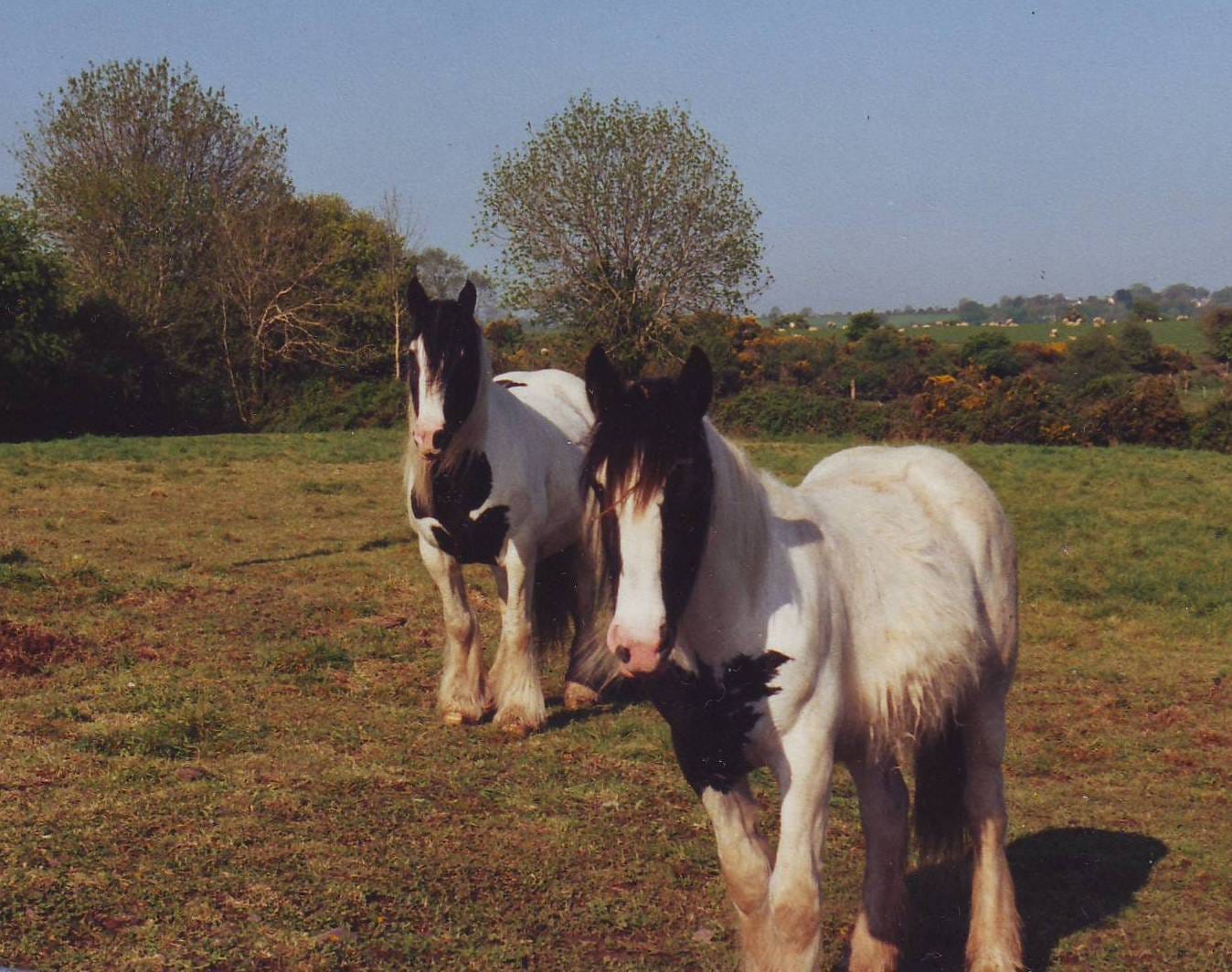
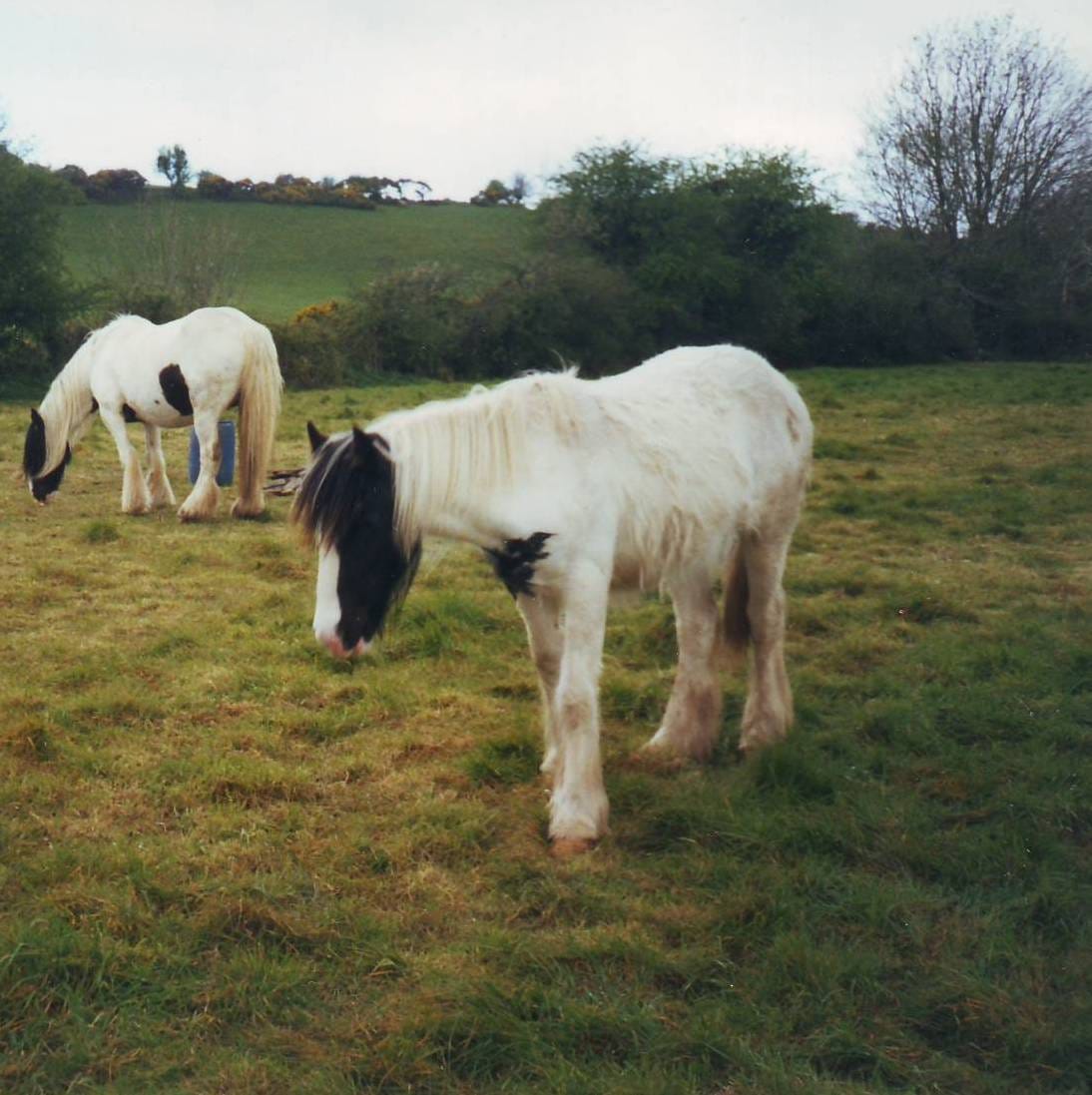
The “horse” when delivered was two horses, a mare and a foal. The horses were attractive creatures in a rugged sort of style. Very sturdy in the legs and haunches but with a rather coy sort of facial expression because of the fringes which covered their eyes.
We would be doing Mr Connors a favour by feeding the horses with our grass; the horses would be doing us a favour by keeping the grass under control. They did a very good job. Another bonus for us was that they produced mountains of organic matter for our crops. I have been told that one horse produces 50 pounds of manure a day, although I did not weigh it. It was just impossible to keep up with the turd-machines. They would not consider eating grass from an area they had plopped on, but they did so much plopping that one would have to work 24 hours every day to keep it clear. I decided to adopt a philosophical attitude. The longest journey starts with a single step. One turd at time, sweet Jesus, one turd at a time. I was working ten-hour days shovelling shit. This was a refreshing change from my office days when the shit was usually being shovelled on me. How do horses manage to produce so much shit just eating grass? The mountain of manure nicely rotted away until it was positively steaming. It had a lovely nutty fragrance and was almost good enough to eat.
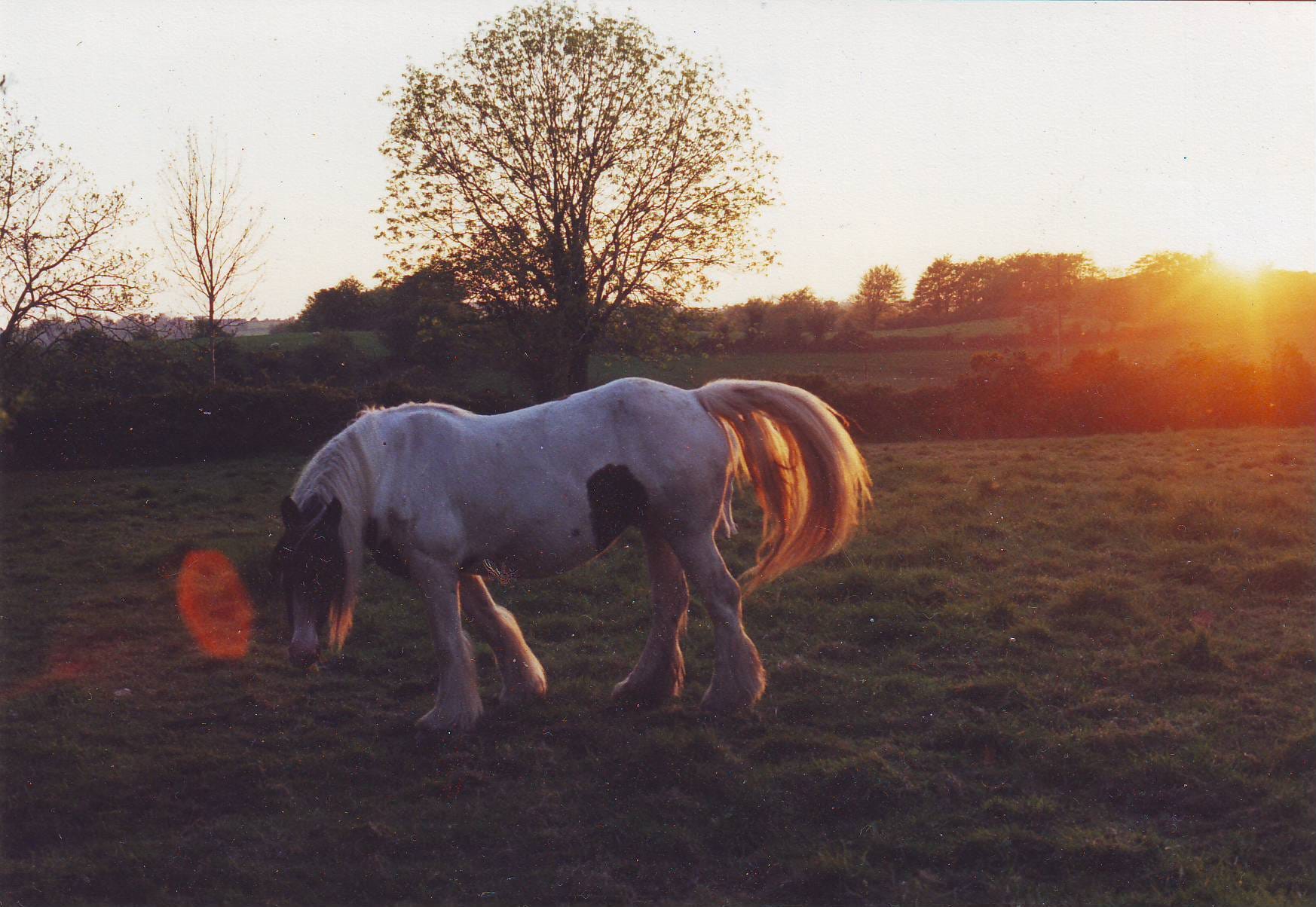
It was a beautiful picture, the horses in the twilight. The sun low in the evening sky laid a dusting of golden light over the fields. The dying sun was reflected pink in the pond. A metallic blue dragonfly rested on the water lilies, like a helicopter from another planet. Small flies were attracted like moths to a flame to the shimmering reflected light and pattered like raindrops on the shores of the water, littering the surface, providing excess for the fish. Tall, swaying, purple lances of foxgloves lined the boreen up the hill.
In the morning, blades of grass were covered with dewy cobwebs like lacy sequinned shawls. In days to come, thanks to the manure, we were to harvest vegetables from the garden, cracking open broad-bean pods freshly plucked, warm from the morning sun, thumbs feeling the warm furry quilt inside the pod, revealing new shades of green. Swifts made swooping passes over the pond rising with jewels of water dripping from their beaks. They took off vertically, arching backwards to make perfect landings on a wire.
In my naiveté, I had imagined that the animal(s) would be with us for a day or two. Mr Connors assured me that he would drop by on a regular basis to check on the creatures. He gave me a (mobile) telephone number so that I could contact him in an emergency. During the several weeks that the horses were with us, I tried to contact him on several occasions. Mostly his phone was switched off. When I did speak to him, he said he was fully engaged up in Dublin visiting a friend in hospital, or in Wexford trying to hunt down a horse-box. He repeatedly assured me that the beasts were very gentle and would be no trouble.
My wife, being a person of an interfering nature who is always interfering with nature (in her zeal to rescue an insect from a puddle, she will not consider that she is coming between a frog and its lunch), felt that a diet of plain grass must be a trifle dull for our guests, so provided turnips, carrots, apples, cabbage and the like of a morning.
The allegedly meek creatures came to expect such luxury and created a terrible commotion when we had the temerity to lie in and delay their breakfast. The foal became particularly demanding, hammering on the kitchen door, stamping about on corrugated iron and swinging a seedling plum tree around in her teeth. The mare was singularly lacking in maternal instincts, ensuring that she got both helpings of breakfast by biting the child in the rump and chasing her away.
Perhaps in reaction to this parental abuse, or perhaps because of a rebellious nature, the foal escaped into the next field for a few days and had to be enticed back by our farmer neighbour, John Barry, with a bucket of oats.
Then, one morning my wife awoke early thinking that she could hear a horse cantering down the lane. Fearful that we would be once again one horse short of the full complement delivered to us, I got up to go and check in the field. I returned to report that the two were all present and correct and, in fact, they had a third companion.
The mare had given birth to another foal. The cord had been cut and the afterbirth was steaming on the ground. The new foal was breathing and shivering but otherwise not moving much. Every so often, she would try to get to her feet, but her back legs were not strong enough to support her flimsy weight. We couldn’t get close enough to help because the mare was standing guard and would stamp and snort aggressively when we approached.
I paced up and down the lane in the hope that a passing tractor would bring a farmer to me who would know what to do in such a situation. The whole area was uncharacteristically deserted. There was no reply when I telephoned our farmer neighbours. There was no reply from Jerry Connors’s mobile.
A woman came past with a huge Alsatian on a great thick hairy rope which was wound around its jaws like a muzzle. The woman carried a plastic bag full of oranges and their peel. We chatted for a while about the unusual amount of rain we were having. I asked her if she knew anything about new-born foals. She confessed that dogs were her main area of expertise, peeling another orange and extolling the miraculous properties of vitamin C.
I explained the situation to her, and she embarked upon a lengthy discourse on the travelling people. It was one of that class of discourses that begin, “There’s good and bad in every community”. It appeared that there was “a gang of travellers up above” near where she lived who did not meet her standards of animal care in the way they treated their dogs. “All they’re interested in is maintaining a yuppie lifestyle with their Armani suits, flashy cars and their mobile phones!”
I telephoned Jerry Connors again and, surprisingly, managed to speak to him. He kept to his promise to come within an hour. He, his wife and granddaughter seemed very competent and confident and gave the new-born foal an injection and got her on her feet. They took all three horses away.
Needless to say, no money was forthcoming, but Mrs Connors assured me that God would bless me for my kindness and that land on which a foal had been born would be lucky and fertile. She wanted me to purchase jewellery and Rolex and Cartier watches, but I was obdurate in my refusal.
She unloaded a “Persian rug” on me, free of charge.
Mick, our builder’s apprentice said:” Persian rugs, me bollix”.
The labels on the rugs said, inexplicably, “Made in Belgium”.
Wonderful Story, told in an the entertaining style that only an Irishman can muster
Michael, your story is absolutely amazing! It's a thrilling mix of rural adventure, Travellers' wit and equine surprises. We're so grateful that you let us roam those fields with you!