
Double Anniversary
My brilliant career.

Today, February 16, 2025, is a double anniversary for me. On February 16, 1970, 55 years ago, I started work at the social security office in Cornwall Street, Openshaw on the outskirts of Manchester, about three miles east of Manchester city centre.
On February 16, 1997, I had my retirement party at Wellington House near the Old Vic.
In 1970, I was sharing a flat with three male friends in the pleasant suburb of Didsbury, which is on the north bank of the River Mersey, 5 miles south of Manchester city centre.
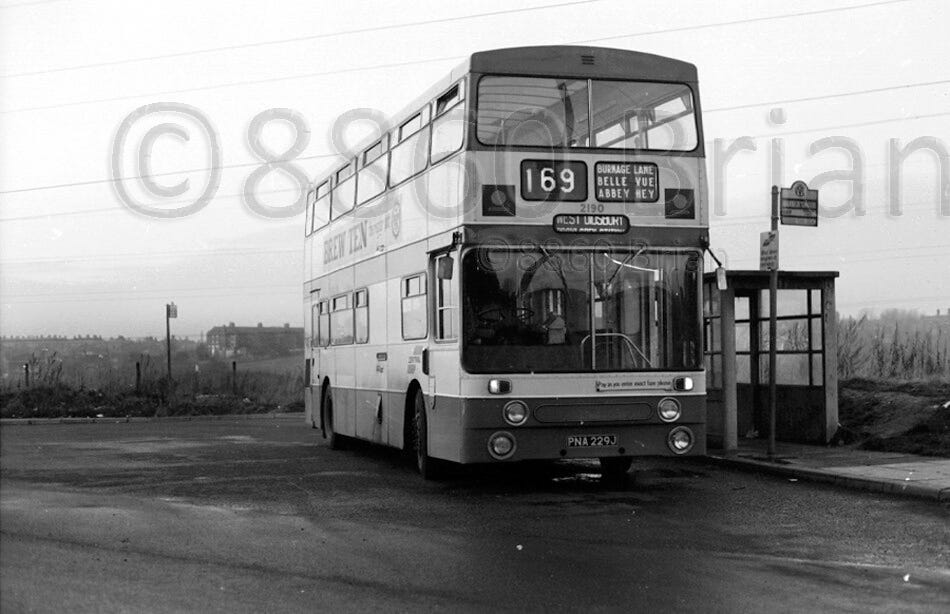
There was a bus route that took me directly from my home to my work. The 169 and 170 were old Manchester Corporation routes which ran from Didsbury into Droylsden, the 169 branching off at Market Street to serve Greenside Lane, whilst the 170 continued towards Droylsden Station terminating at Lumb Lane.
This was more than a physical form of transport. I was being teleported from a middle class world of civilised culture and good manners to a hell hole of poverty and mental and physical deprivation.
On my first day, I was late because I got off the 169 bus too soon and walked along Ashton Old Road in the wind and snow. There were many derelict buildings because the old slums were being cleared and new slums were being constructed. Those replacement slums have now been demolished. As I struggled through the snow, I recognised many of the street names because I had been reading Emlyn Williams’s book on the Moors Murders, Beyond Belief. One of my office colleagues had known Myra Hindley.
The atmosphere in the Cornwall Street office would be unrecognisable today. Everybody smoked, so one’s eyes would be stinging and one’s clothes reeked. Although the civil service retirement age was 60, most of the men seemed ancient. The second world war had ended only 25 years previously and many of these men had served in the armed forces. George Bill, who was heavily Brylcreamed and had a dapper little moustache, was constantly telling anecdotes about his days in the RAF. Cheeky young clerks called him “Biggles” and “Wing Commander Bill”.
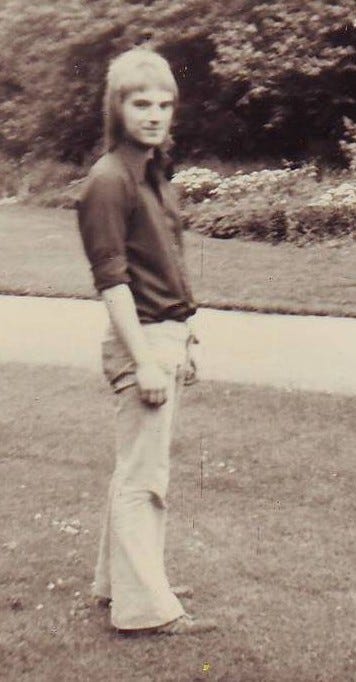
Most of the older men in the office were revoltingly lecherous and personified the concept of male chauvinist pig. The women did not like the way they were treated by these oafs but had to put up with it. As a long-haired graduate (shockingly incompetent at the work and prone to taking lots of sick leave), I was not popular with the old male neanderthals, but the women found me a refreshing change. I received a better education at Openshaw than I had at Manchester University.
I wrote some poems about Openshaw.
SUMMER IN THE CITY
Throughout this first day of almost summer,
They have poured out of their dark and dusty terraces.
In Abbey Hey Park the old and the halt,
The wage slaves and the petty clerks,
The jobless and the feckless,
Have tried to enjoy the blue but airless sky.
In Abbey Hey Park, young women skiving from Atora,
Tresses lank from their work,
Faces pustuled from the suet
Usurping their sebum,
Broiled gently under the low flame of the sun.
A young mother in a short skirt,
Exposed shins mottled and marbled,
Brindled like brawn by her winter fires.
She hoped the sun’s blessing would heal
Her flesh, erase the purplish yellow
Shadow about her cheekbone.
Pale, sandy-haired children have smeared their faces
With Mr Softee and fingered dog turds,
Baked white in the sunshine.
In Abbey Hey park, hennaed women offered
Varicose veins in benediction to the heavens.
The sun is a glob of phlegm
Hawked westward from the rubber works,
Slithering down the greasy sky over the suet factory.
As the sun sets in the mad alien fire
Of the polluted sky, women’s bodies, sweaty,
Glowing from the heat of a long day,
Freed from imprisoning foundation
Garments, flounder, squeak and slide
Across plastic sofas draped with laddered tights.
Laughing hips flop in defiance of loosened girdles.
As the sun descends to its nadir in the now infernal sky,
Dentures are abandoned to swim or sink
In pint pots of water. They grin back at their owners
In a rictus saying, “You’ve got to laugh”;
And “Mustn’t grumble”; and” Tomorrow’s another day”;
And “You don’t have to be mad to work here”;
And “We’ll all be pushing up daisies one day”.
GHOSTS
A dog’s body
Is deficient for the challenge
Of a charging bus
And becomes mere matter
For the flies to kiss.
Mind over matter.
A dogsbody in the wireworks
Was crushed to matter
Under a toppled crane.
He didn’t matter to anyone much.
They didn’t mind
Getting another from the labour exchange
Didn’t mind sending some flowers.
The “purveyor of fine meats”
“Is pleased to meet you,
And has meat to please you”.
An ultra-violet insect repeller
Hums and gives out a purple glow
Like an undertaker’s neon sign.
A bluebottle settles with a
Cyclorrhaphous
Languor on a lamb carcass.
Among dripping cadavers of cows
And smaller pieces of mutilated animals
The butcher reads in his news paper
Of carnage and mayhem in Ireland
And frowns.
Reflections of derelict houses
Mingle with sample headstones
In the funeral director’s window.
He’ll always do a good trade here.
Old people steal
From the social to put money by
To be respectably buried.
Crepuscular purple light
Casts a mortuary pallor
On crumbling streets,
Where generations of spirits were stunted.
Strips of brown wallpaper
Flap in the spiteful twilight.
A dead armchair still bears the greasy
Imprint of some Brylcreamed pate
That now may be a hollow skull
Growing weeds.
Green weeds and dandelions
Sprout stubbornly
Where hungry childhood died into vicious
Querulous old age.
Human spirits become carrion
For voracious vegetation.
What a carry on!
How do they carry on?
Why do they carry on?
The street names here
Give a frisson if you have read
Beyond Belief.
Years ago, when there was some kind of life
In these houses,
Hindley and Brady trod these pavements,
Carrying in their minds
The unthinkable,
Seeking children to torture.
Do the ghosts of their victims
Socialise with the factory-maimed?
Do they compare and contrast
The respectable and bureaucratic
Mutilations
With the perversion that sickens us all?
RELICS
Old stomachs rumble
Behind watchchains.
Time is buried in linty recesses
Of brown serge.
Old minds, stifled
In shiny brown wallpaper
Fade beneath flat caps.
On Thursday morning
The pillar box
Is so certainly scarlet
Outside the Post Office.
Old women, pension books
Slimmer by another order,
Arthritically finger their change,
Reckoning the chances
Of buying one more week.
URBAN RENEWAL
It’s a jungle out there.
Jungle sounds.
The damp echoing of a diesel’s klaxon.
Feline hiss of wet tires.
It’s a jungle out there.
The pocked yard fills with oily pools.
A distant, unidentifiable irritant
Like a dentist’s unceasing drill.
A night like an aching tooth.
An eighty-year-old woman is dying
In a state of siege.
Her body shrinks,
Eroded by insidious
Winds of time.
Her spirit dissolves
Imperceptibly into fog.
It’s a jungle out there.
Outside, a derelict wilderness
Gestates predatory creatures.
Loose bricks that once formed the homes
Of friends and family,
(Now dead or dispersed
In the diaspora of the downtrodden,
Disappeared by council decrees
Into spanking new slums in the sky)
Thud against her door
In the long threat
Of the night.
I did a summer job while a student at Manchester Uni in the late 90s, which was supposedly 'sales and marketing.' It involved dragging two huge bags of cheap consumer products made in India around Greater Manchester factories, workplaces and pubs and trying to get the poor sods working there to buy these tiny radios shaped like ghetto blasters, kitchen gadgets, calculators and useless electronic tat. Openshaw was one of my regular patches. It was half derelict and half demolished then, with sporadic bits of retail or autoshops. I would go into the pubs down Ashton Old Road and they'd let me sell to the customers, though it was slim pickings. I was continually asked if I had any cheese, coffee or bacon. The scallies would shoplift these things and hike them round all the pubs of the area where much of the custom was pensioners on very low incomes. I wonder if the place has changed now Manchester is increasingly gentrified.
Davey Jones of The Monkees was from Openshaw.