
Blaise Away
Some random ramblings covering much time and territory, which might be of interest to my loyal subscriber, Bromley Man.

Throat Man
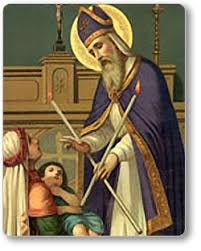
One of the many useless facts I have known for a long time is that if you get a fish bone stuck in your throat, St Blaise is the go-to-guy. St Blaise is yer man. Blaise is the patron saint of people with fish bones stuck in the throat. I remember my Uncle Ted, my mother’s brother from the Cheltenham lot, with their airs and graces, a “regency house” and daughter having ballet lessons, Uncle Ted got a sharpy-ended chip stuck in his throat which caused a lot of blood. Could St Blaise have helped old Ted out? Ted looked like Cardew Robinson.
I am having a bit of a tickly throat at the moment so I decided to give old Blaise a more thorough check out.
Venerated Elite
Wikipedia quickly apprised me that Blaise was not just anybody. He was an honoured member of an elite group known as the Quattuordecim auxiliatores. The Fourteen Holy Helpers are particularly venerated because their intercession is believed to be especially effective against various diseases. This group was assembled in the Rhineland in the Fourteenth Century by German Catholics seeking help against the Black Death. Blaise was one of the 14 with a speciality in the throat department. He has a sideline as the patron saint of woolcombers. This will be significant later. Is there a patron saint of woolgatherers? Saint Blaise is also the patron saint of the wild beast.
Real Turkish Blaise
There was a real historical Blaise who lived in what is now the modern state of Turkey. A disproportionate number of Christian saints came from what is now Turkey. I have visited the cave dwellings at Myra where St Nicholas (Santa Claus) was bishop. St George is the hero of English Nazis but he was born in Cappadocia – he would be scorned by the St George’s- flag-waving Neanderthals as a Turkish immigrant. St John the Apostle is believed to have lived and died in Ephesus. A modern beer still bears that name. I remember from my visit to Ephesus, that there was a famous brothel there in ancient times. The customer always comes first. The Brothel of Ephesus is the building located at the crossing of Marble Street and Curetes Street. It is believed to have been constructed in the 1st century AD about the same time as the baths and the latrines. A statue of Priapus with an oversize phallus was excavated from the house. There was a sign showing that the library was directly across the street. The twin martyrs Cosmas and Damian were physicians who practised medicine in Aegeae, Cilicia, modern-day Çukurova. Cyprian and Justina were were martyred in Nicomedia, modern-day İzmit.
Hágios Blásios was born around 280 AD in Sebastea, Cappadocia to wealthy and noble parents and was raised as a Christian. The legend has it that Blaise studied philosophy in his youth, was a doctor in Sebastea, the city of his birth. When the bishop died, Blaise was appointed by public acclamation. This was because he had demonstrated his goodness and special powers. People came to him to find cures for their spiritual and their physical ills. Even wild animals came in herds to receive his blessing. In 316 AD he was arrested by Agricola the governor who had a remit to kill all the Christians in Cappadocia.
As Blaise was being led to jail, a mother set her only son, choking to death on a fish-bone, at his feet, and the child was cured straight away. They met a poor woman whose pig had been seized by a wolf. At the command of Blaise, the wolf restored the pig to its owner, alive and unhurt. These days it would be hard to find a bishop to do that class of a thing. These days they just wander about in their night clothes stopping decent people singing.
The governor, unable to make Blaise renounce his faith, beat him with a stick, ripped his flesh with iron combs, and beheaded him.
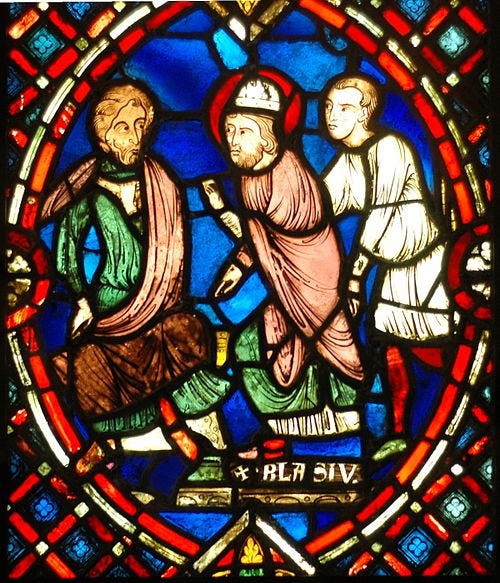
San Blas
In South America , Saint Blaise is known as San Blas. I encountered him in Peru. There is a neighbourhood in Cusco that has a bohemian feel to it and is quieter than the rest of the city, which is usually swamped with tourists on the way to Macchu Picchu. Some say the best eating place in San Blas is Jack’s Café which is Irish-owned (Gary Feeney). Those Wild Geese get everywhere
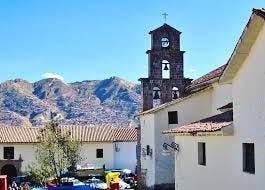
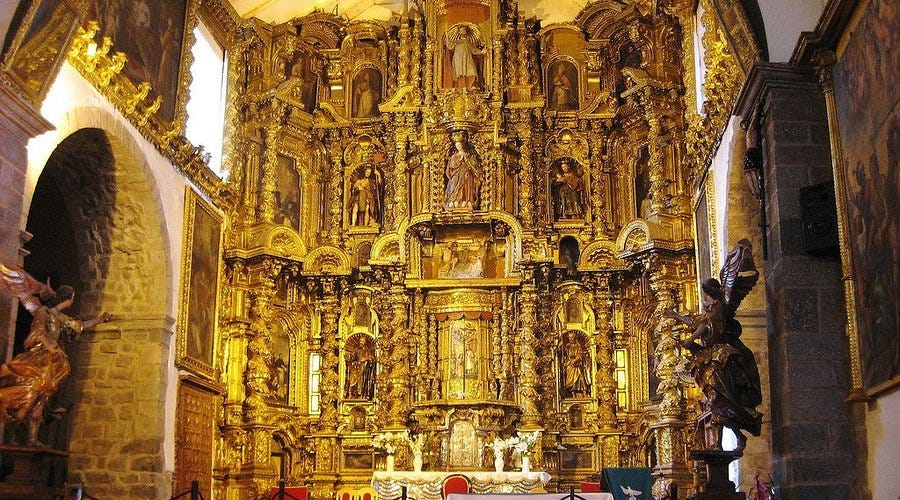
I remember the Iglesia San Blas. It looks ordinary from the outside but if you climb the belfry you get an astounding view of the city. The Church of San Blas was built in the 16th century on top of an ancient Inca sanctuary dedicated to Illapa, the god of thunder, lightning, and war. The church was originally built with mud bricks, but after the earthquakes in 1650 and 1950 it was rebuilt with stone walls. The stone bell tower was constructed after the 1950 earthquake, replacing the original tower made with mud bricks. What really stuck in my mind was the pulpit. It is carved from a single piece of wood and decorated with figures of angels, saints, and other religious motifs. This masterpiece is attributed to the Quechua master craftsman Juan Tomás Tuyro Túpac. Others give credit to Martin de Torres or Diego Martinez de Oviedo. In reality, no one is certain of the identity or the artist/artists that made it or how long it took to make. Allegedly, the artist’s skull is at the top.

The altar is also rather spectacular.
Bromley
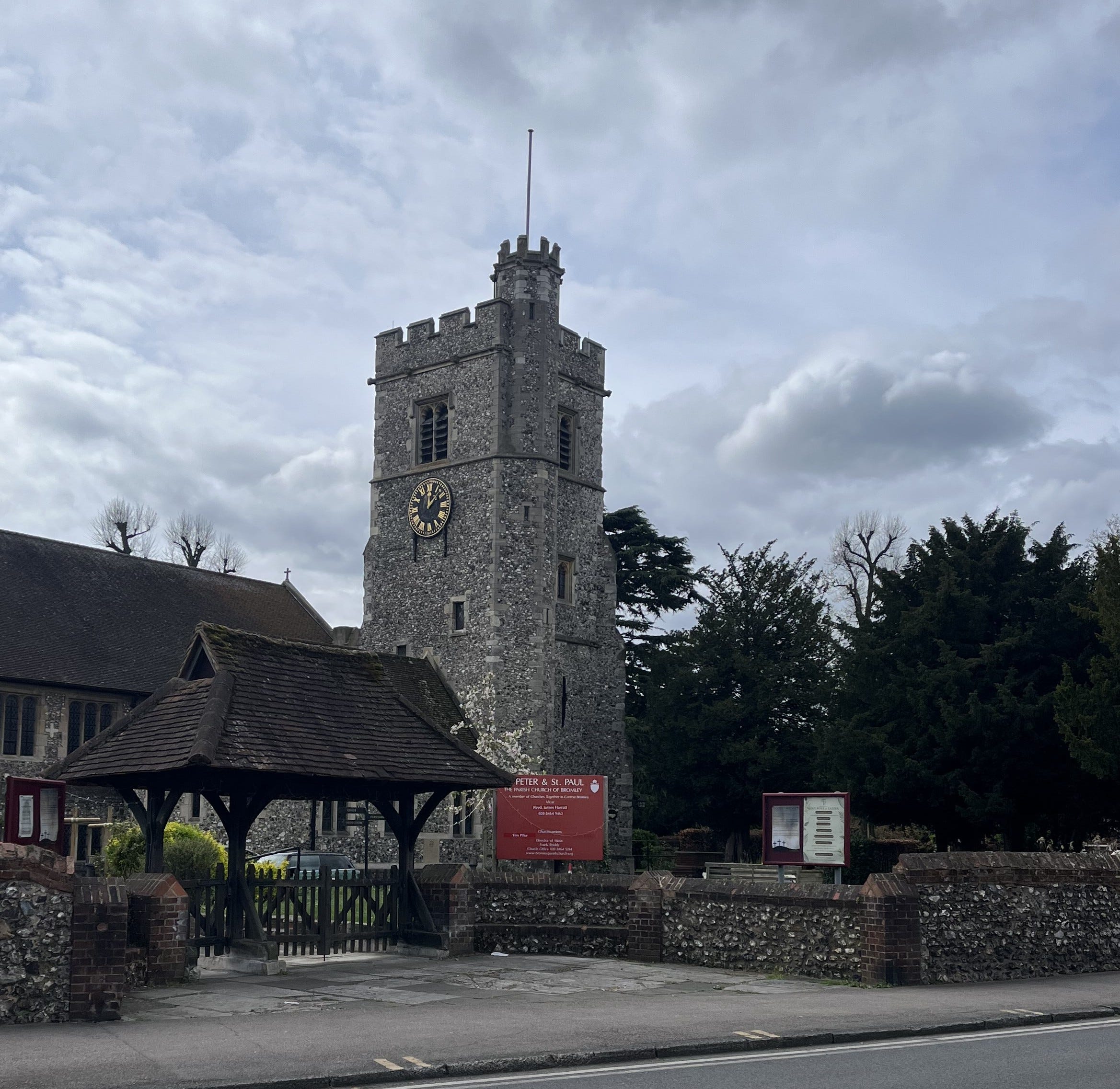
It is a long way from San Blas in Cusco to Bromley in Kent – around 10,000 km to be imprecise. I fell in love with Bromley when I was living in Lewisham in the early 90s. I used to hop a bus with my travel card and wander around the Bromley shops and pubs. In more recent years I have been spending a lot of time in Croydon and hopping the SL (Superloop) 5 limited stop bus to Bromley and enjoying the wonderful variety of restaurants that Bromley has to offer. A visit to The Glades makes journeys into central London unnecessary – there is a huge Waterstones bookshop, a massive M&S Foodstore, an Apple Store, Lidl and Primark. Just around the corner from Primark, you would think you were in a country village. There is an Anglican church with extensive grounds. The Church of St Peter and Saint Paul offers free organ recitals.
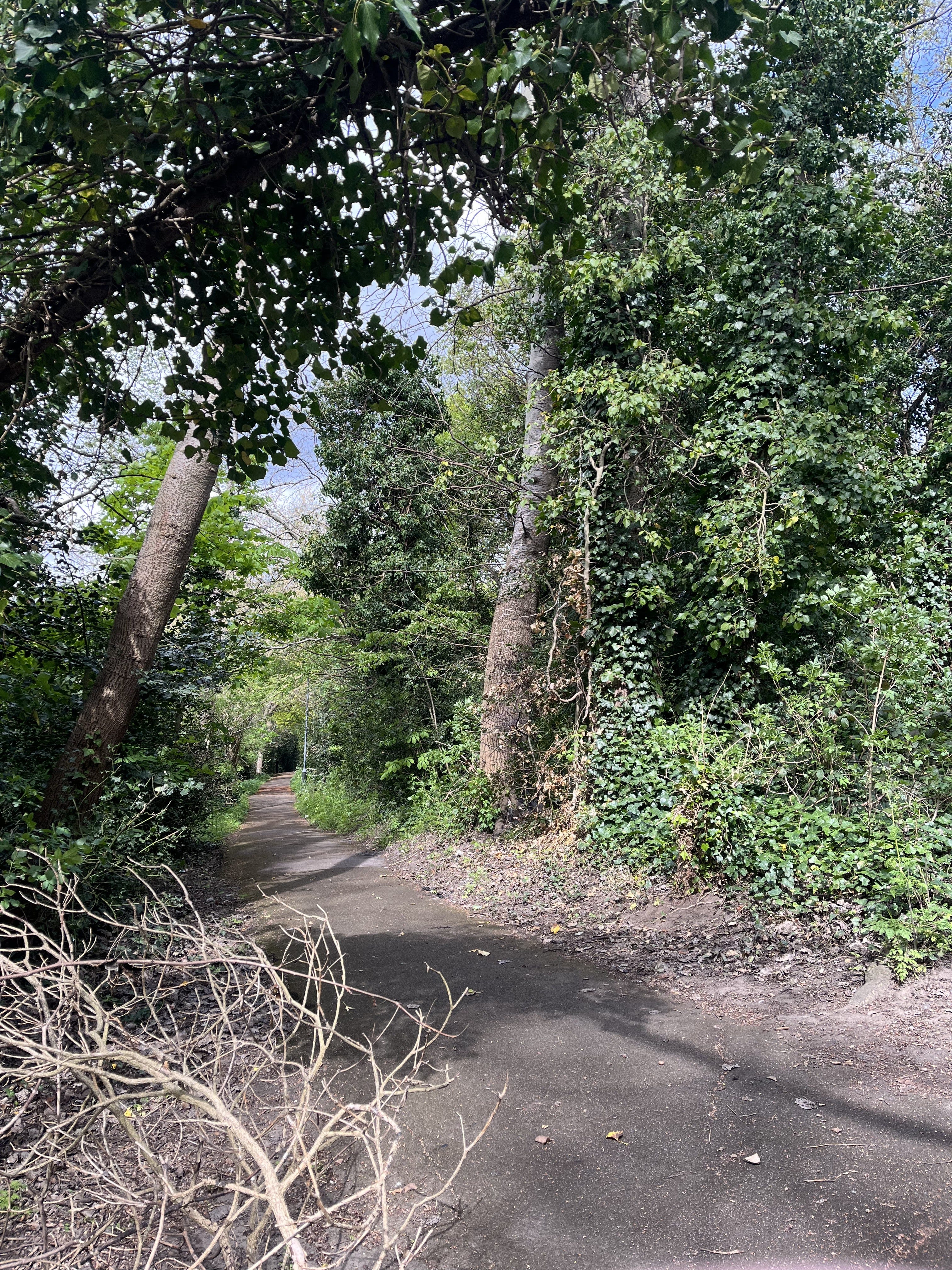
Just beyond the church is a park with steep walks down overgrown country lanes.
Back in the early 90s, I saw a production at The Churchill Theatre of Bill Naughton’s Alfie starring my one-time looky-likey, Adam Faith. The Churchill is still going strong today. Beyond the theatre is another rural walk including a lake with some aggressive geese. I witnessed a wild goose chasing.
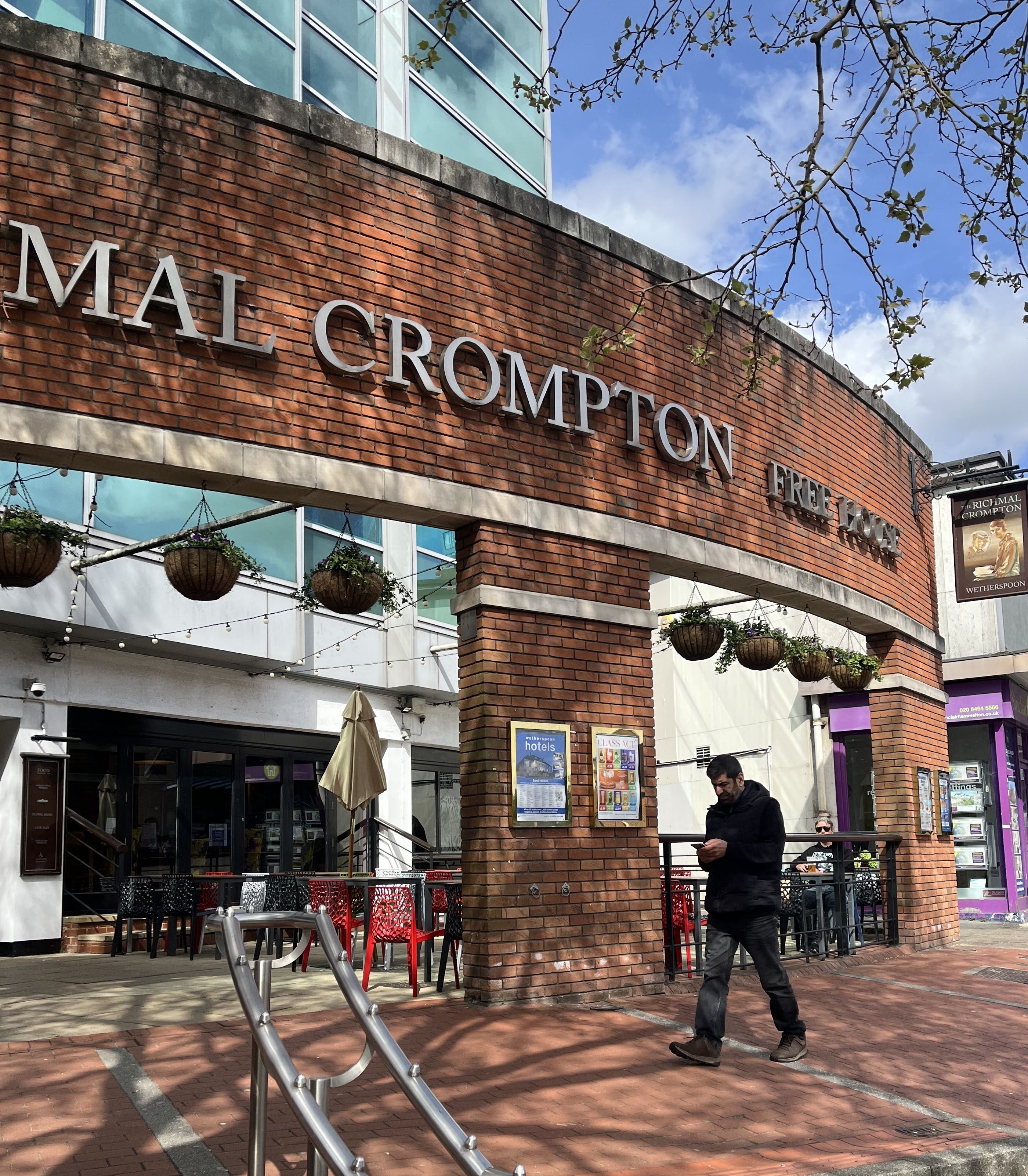
Bromley has literary connections. A new feature to me was a pub called The Richmal Crompton. Unfortunately, I will be unable to enjoy that hostelry as it is part of the JD Wetherspoon’s chain owned by Tim Martin whom I have been boycotting because of Brexit. Richmal Crompton was the creator of the indomitable William Brown. There is an excellent biography of Richmal Crompton by Mary Cadogan (who worked for Krishnamurti for 20 years). I remembered from my reading of Cadogan’’s book that Crompton was a northerner born in Bury but had forgotten the connection with Bromley. At the age of 27 she went to teach at Bromley High School where she was an excellent and committed teacher who also managed to pursue her writing career. She was successful enough with her writing to be able to give up teaching and to afford to buy a house in Cherry Orchard Road on Bromley Common for herself and her mother.
Other literary giants from Bromley include HG Wells who was born at 162 High Street in 1866. Another was Hanif Kureishi, who peopled his novel The Buddha of Suburbia with characters from Bromley (plus David Bowie from Beckenham). Kureishi was less fortunate than myself after a fall. Talbot Rothwell, writer of many of the Carry On films was another Bromley literary giant.
Blaise and Bromley
My woolgathering has led me to find connections between Saint Blaise and Bromley. One can often be surprised at how far afield people managed to travel in the olden days. I would however doubt that St Blaise managed to get to Bromley from Turkey between 280 AD and 316 AD. There was no superloop in those days and no Oyster Cards. I enjoyed a tasty lunch, washed down with a glass of robust red wine at a Turkish restaurant. I did not get a fish bone lodged in my throat.
Wellness Well
Although Blaise did not visit Bromley, he is remembered there. A fair was held every year in Bromley on St Blaise's day (February 3) and it was claimed that Bromley parish church may have been originally dedicated to the saint. Blaise was patron saint of woolcombers and Bromley was dependent on the wool trade. St Blaise's Well is a holy well in the grounds of the old Bishop's Palace which is now part of Bromley Civic Centre. King Ethelbert II of Kent granted the original spring to Bishop Eardwulf in 750 AD. The well into which the spring flowed eventually became a place of pilgrimage and an oratory in honour of Saint Blaise was built close by. The well was much frequented, not only on account of the medicinal value of the water, but for the sake of indulgences (or remittances of penance) which Lucas, legate to Pope Sixtus IV, granted to all who offered up their orisons at this oratory of St. Blaze, in the three holy-days of Pentecost.
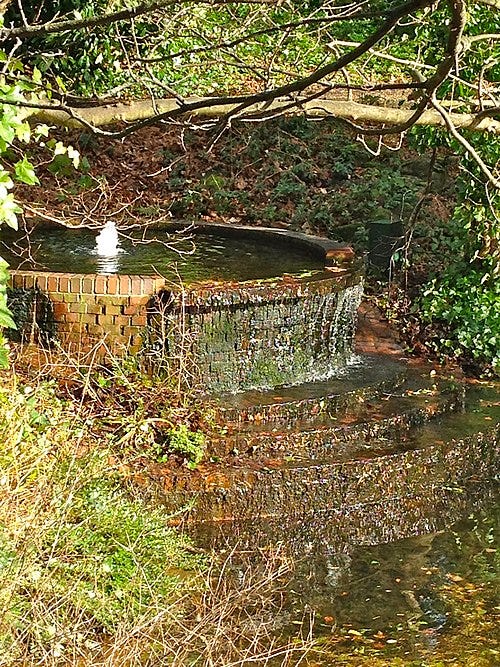
The spring water which fed the well was chalybeate. Royal Tunbridge Wells also has chalybeate springs. Chalybeate water is mineral-rich, specifically containing iron salts, giving it a distinctive metallic taste and sometimes a rusty appearance. Although it was once popular for purported health benefits, it's now understood that the iron content is relatively low and of doubtful benefit. Besides iron, chalybeate waters may also contain other minerals like manganese, zinc, and calcium.
After the Reformation, the oratory fell into ruin and the well was not used. It became buried and forgotten. In 1754, it was rediscovered by a Mr. Harwood, the Bishop's chaplain, who noticed a "yellow ochrey sediment, remaining in the tract of a small current, leading from the spring to the corner of the moat, with the waters of which it used to mix".
An account of the rediscovery, and the use of the water, was published by a surgeon, Thomas Reynolds. Reynolds wrote that "the water of this spring is much richer in mineral contents than the water of Tunbridge Wells".
The site became neglected again in the 19th Century. The well was eventually reconstructed and now stands in a Pulhamite (Pulhamite was a patented anthropic rock material invented by James Pulham)) rockery on the edge of a small lake.
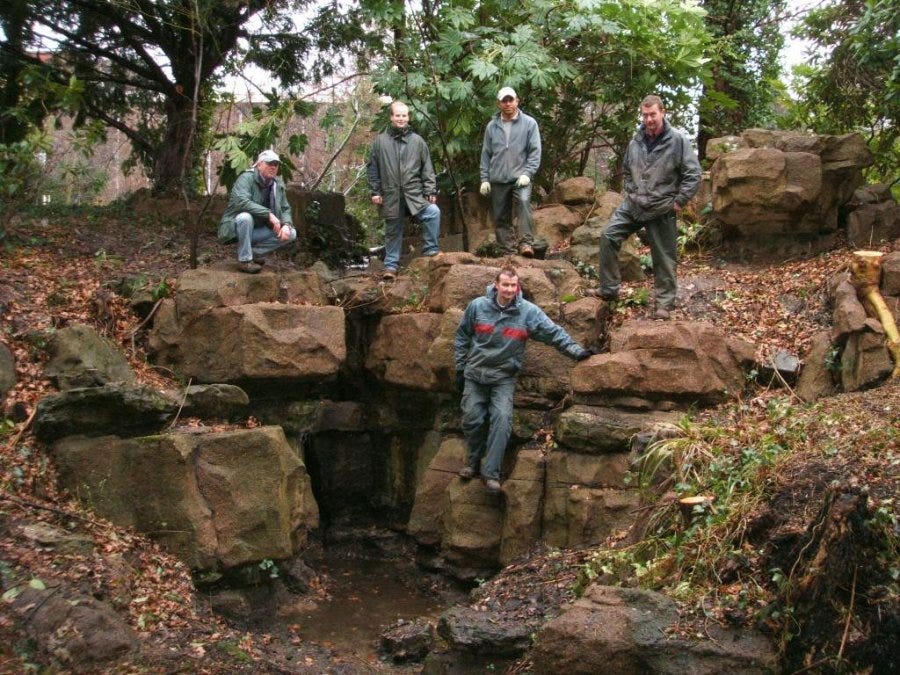
The outfall from the well flows into a lake which was part of a Medieval moat which surrounded the palace, probably to provide fish to the bishop.
Careful with those fishbones!
Are you planning to keep this up? You will be exhausted. But a really good read.
Now I've read it. You need to cone and live in Bromley - or somewhere so close you can Superloop it with ease.....