
Argy Bargy
Cheating at a hyper-surreal level.

Antonio Rattín died at the age of 89 on July 11, 2026.
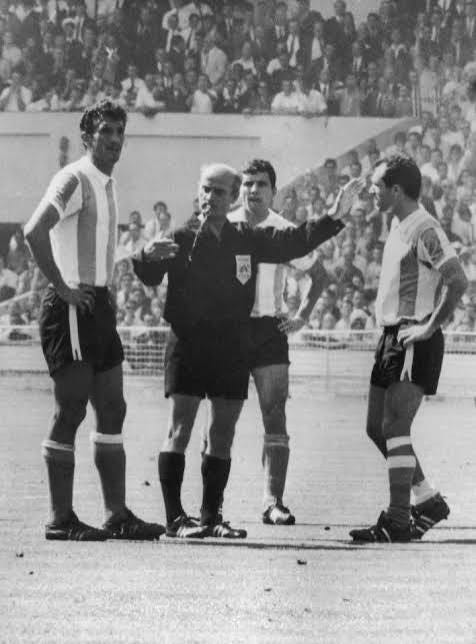
Malvinas and Football
When celebrating their defeat over England in the 2026 World Cup semi final, several Argentinian players—including Giovani Lo Celso, Nicolás Otamendi, Lisandro Martínez, and Cristian Romero—displayed a banner that read: “Las Malvinas son Argentinas”. Rattin’s heir as Thug-in-chief for Argentina, Leandro Paredes, explicitly defended the team’s decision to pose with the banner, stating that the 1982 Falklands War remains a deeply painful chapter in Argentina’s history that the players will always carry with them. The crimes of the junta must also be deeply painful to some. The dictatorship of the guys that dropped their opponents out of helicopters is pretty painful. FIFA strictly prohibits political statements, meaning players involved could face suspensions.
Andrew Giuliani (dread surname!), head of the White House FIFA taskforce, defended the Argentinian players’ right to wave the banner. He argued that because the tournament was being hosted in the United States, the team was protected by First Amendment free speech rights.
I was working in Ashton-under-Lyne when Mrs Thatcher took on the Argentinian Junta. I did not meet Angela Rayner in Ashton-under-Lyne. While the conflict was unfolding, my colleagues and I spent a lot of time in local pubs and following up on cheap spirits in Yates Wine Lodge. I do not recall a patriotic enthusiasm for the South Atlantic endeavour in our conversations. I was of a leftist leaning and no fan of Thatcher, but likewise no fan of the military dictators of Argentina who used the Malvinas as a distraction for the appalling condition of their country.
Malvinas and Me
In 1983, I spent some time in South America. It was not a good time for someone with an English accent to be there. My main destination was Peru, but the long flight from London to Lima required several stops which involved me setting foot in a few South American airports. These days, flights from London to Lima generally take between 15 and 18 hours. In 1983, it took longer because commercial aircraft lacked the range to fly non-stop from continental Europe to western South American cities like Lima. To bypass the Andes and cross the Atlantic, European carriers routinely operated multi-stop “milk runs” to South America. Iberia used its flagship widebody fleet, the McDonnell Douglas DC-10-30, specifically for these multi-stop Caribbean and Latin American routes. The aircraft needed to refuel, and the flight crew had to be changed because of duty-time limits. The cabin had to be cleared of cigarette smoke. Imagine that!
We hung around the transit lounge at Luis Muñoz Marín International Airport, San Juan, Puerto Rico for about an hour. Then we landed at Bogota where I wandered around the shops and thought of Bobby Moore. The next stop was Quito where the Mariscal Sucre International Airport is set in the middle of a high-altitude mountain valley, surrounded by residential high-rises.
I Went to South America and Saw Some Lousy Malvinas T Shirts.
I suppose we should have expected it but it was somewhat disconcerting to encounter people wearing Malvinas t-shirts.
We visited Huancavelica. The city is situated at an approximate altitude of 3,676 meters. The population in 2026 is 61,615. of the population speaks Quechua as their mother tongue. It is considered one of the poorest cities in Peru. For a long time these people have been suffering the ravages of extractive colonialism. The mercury deposits of Huancavelica were disclosed in 1564. The Spanish Crown appropriated them in 1570 and operated them until Peruvian independence in 1821. In 1648 the Viceroy of Peru, declared that Potosí and Huancavelica were “the two pillars that support this kingdom and that of Spain”. Moreover, the viceroy thought that Spain could, if necessary, dispense with the silver from Potosí, but it could not dispense with the mercury from Huancavelica.
Mercury, lead, and arsenic contamination from centuries of quicksilver mining exposes Huancavelica’s residents to neuropsychological damage, kidney damage, fertility problems, and cancer. Pregnant mothers, foetuses, and children are most vulnerable.
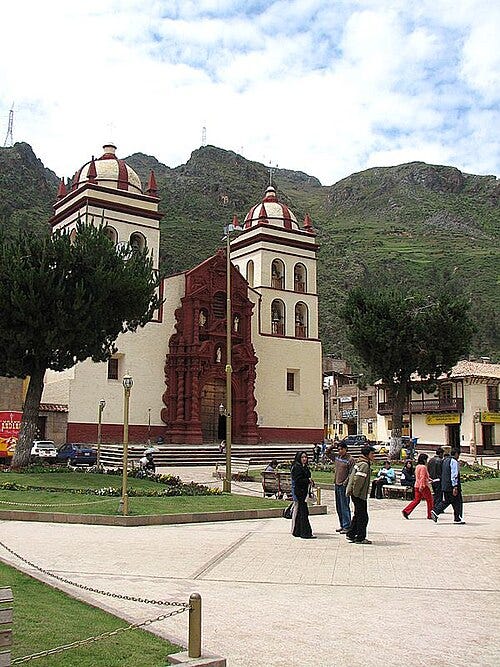
We went to a cultural festival at the Catedral de San Antonio or Iglesia Mayor de San Antonio de Huancavelica. It stands directly in front of the Plaza de Armas, in the centre of the city. The structure was completed in 1608, but its ornate Churrigueresque Baroque altarpieces (retablos), pulpits, and facades were continuously modified, rebuilt, and perfected throughout the 17th and 18th centuries. Somewhat dizzy from the altitude, I was disconcerted to have a very large man with a distinct resemblance to Herman Munster repeatedly saying “Margaret Thatcher” at me. He seemed quite benign however and we did not feel threatened.
Soon after leaving Huancavelica, we reported to a local police station. Some days later, while buying some oranges, I read in a newspaper that that very police station had been blown up by guerrillas from El Sendero Luminoso.
Fraternal Bond
Peru was Argentina’s most loyal ally during the Falklands war. Peruvian President Belaúnde Terry sent fighter jets, and provided military fuel and ammunition to Argentina, bypassing international sanctions. Peru delivered ten Dassault Mirage 5P fighter-bombers directly from the La Joya Air Base in Arequipa (birthplace of Nobel laureate Mario Vargas Llhosa, a beautiful city I would like to revisit). Peru provided French-made AS-30 laser-guided missiles, which could hit the Royal Navy. Peru compromised its own arsenals to replenish Argentina’s dwindling stockpiles. Israel sold a massive stash of weapons to Peru, knowing they would be passed on to Argentina.
This (supposedly) created a sense of “eternal gratitude” among Argentinians. Argentina was a legal guarantor of peace between Peru and Ecuador. This did not stop Argentine President Carlos Menem secretly selling weapons to Ecuador in 1995 during the Cenepa War.
Differnces between Argentinians and Peruvians
We met some Argentinians on our travels in Peru. Our trip was under the “control” of a little chap called César Zárate. César had strong views about national sterotypes. He was most upset when head office told him that another member would be joining our group. César had got used to the existing group dynamics and was comfortable with us. We turned a blind eye to his cocaine sniffing. “We don’t want him with us, do we? He is French. He will smell!” Gerard turned out to be Belgian. He did not smell and was very easy to get on with.
I got the impression that César was not too keen on Argentinians. One night when we were camping in tents in a field near a hotel, a group of Argentinians joined us for our evening meal around a camp fire. We had access to the hotel kitchen to cook our food and César had managed to acquire some large carafes of Peruvian wine. César was polite, as were we all, to our Argentinian guests but I sensed a reserve not natural to César, a certain begrudgery in his hospitality. My impression was that , whatever about the Malvinas, individual Peruvians were wary about Argentinians as a generality.
Porteños (residents of Buenos Aires) traditionally viewed themselves as the “Europeans of South America.” Buenos Aires had been wealthy and cosmopolitan, influenced by Italian and French architecture. Peru is rooted in its Indigenous Incan and Andean heritage. To an Andean Peruvian, Argentinians might come across as bumptious and arrogant. To Peruvians who valued humility, a soft-spoken tone, and deference, the loud, confident, and direct speaking style of Argentinians could seem boastful, condescending, or overbearing. Just like an Irish resident might resent a loud Irish-American colonising a culture they don’t understand, Peruvians often felt that Argentinians treated the rest of South America as their rustic “backyard,” despite the two nations being political allies.
Peru hosted many Argentinian intellectuals and artists fleeing from the repressions of the military dictatorship. Cusco became a haven for South American counter-culture, hippies, and travellers. Thanks to Mrs Thatcher the dictatorship fell and the Argentine economy imploded with hyperinflation. Travel to Europe was impossible for most, so young Argentinians migrated to Peru, often opening small businesses, artisanal shops, or restaurants in places like Cusco.
On the other hand, Peruvian migrants in Argentina have faced systemic barriers and casual discrimination, occasionally being unfairly stereotyped about crime and drugs.
Bodacious Cowboys
The stereotypes surrounding Argentinians are deeply rooted in history, geography, and a fiercely competitive culture. These perceptions mostly apply to porteños, but they heavily influence how the entire country is viewed globally. In countries like Brazil, Chile, and Uruguay, Argentinians are often stereotyped as having a massive ego. Because a massive wave of European immigration (primarily Italian and Spanish) reshaped the population in the late 19th and early 20th centuries, a stereotype developed that Argentinians view themselves as superior to, or detached from, the rest of Latin America. A classic regional joke asks: “How does an Argentinian commit suicide? He climbs to the top of his ego and jumps off.”
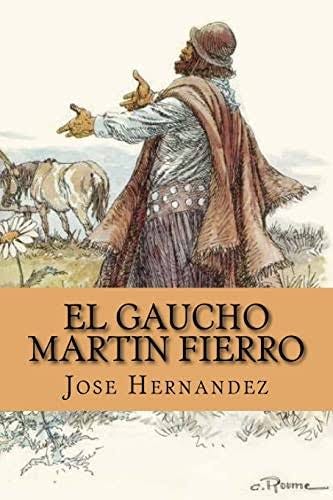
Then there is the gaucho myth. Machismo. The verse novel The Gaucho Martin Fierro by José Hernández is a cornerstone of Argentina’s national and cultural identity. The great Argentinian writer Jorge Luis Borges described the Falklands War as two bald men fighting over a comb. Borges, in his book-length collection of essays El “Martín Fierro”, professed himself to be a great admirer of the work. However, Borges’s reservations about the work have influenced modern readers to acknowledge Fierro’s flaws - racism, and violent toxic masculinity. “Los hermanos sean unidos porque ésa es la ley primera; tengan unión verdadera en cualquier tiempo que sea...” (Brothers must be united, because that is the first law; have true unity regardless of the time...)
VS Naipaul
Naipaul’s 1974 essay “Argentina: The Brothels Behind the Graveyard,” was later published in his 1980 collection The Return of Eva Perón with the Killings in Trinidad. He presents Argentina as a country built on the shaky foundations of a stolen, violent past and ersatz European aspirations.
Naipaul argues that Argentina’s political landscape is a direct reflection of a violent, degenerate form of machismo. He claims sodomy is central to the Argentinian male’s concept of dominance. He used the idea of sodomy to decode Peronism and the national psyche. To Naipaul, a society that normalized what he viewed as a degrading act of conquest was structurally primed to accept delusions and brutal dictatorships. Critics, such as Ian Buruma in The New York Review of Books, remarked upon Naipaul’s own abusive personal sexual predilections.
Argentina has suffered decades of severe macroeconomic instability, hyperinflation, and political turmoil. This has created a unique national psyche: a deep, internal cynicism about their government and economy, contrasted with an aggressive external defense of their culture and identity to the rest of the world. It could be that the perceived arrogance is actually a defense mechanism. Because the country’s economic reality rarely matches its cultural and intellectual potential, a loud sense of pride helps overcompensate for national frustrations.
Argentina and Peru 1978
The 1978 World Cup was an interesting point in Argentina-Peru relations. The 1978 World Cup was played in Argentina. There was not a simple knock-out process. Some complicated league table arrangement brought about a situation where Argentina needed to beat Peru 4-0 to get to the final. They won 6.0. Peru had a good side. They had only conceded six goals across their previous five matches in the tournament, and had topped their first-round group above the Netherlands. The Peruvian squad included legend Teófilo Cubillas. The result knocked out Argentina’s bitter rivals, Brazil, sparking decades of match-fixing allegations and political conspiracy theories. While Ricky Villa and Ossy Ardiles were crucial members of Argentina’s 1978 World Cup-winning squad, César Luis Menotti did not deploy them on the pitch for this controversial game.
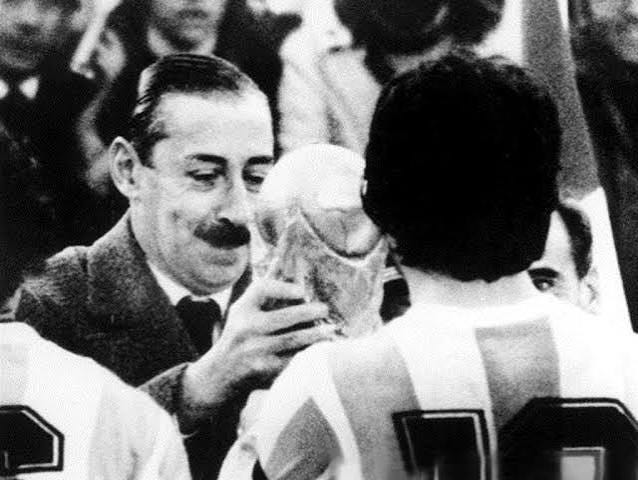
Because the match took place during Argentina’s brutal military dictatorship led by General Jorge Rafael Videla—who used the tournament as propaganda to mask the “Dirty War” human rights abuses happening blocks away from the stadiums—suspicion was immediate. Moments before kickoff, General Videla entered the Peruvian dressing room alongside US Secretary of State Henry Kissinger. Peruvian players later confirmed the visit, noting that Videla gave an ominous, politically charged speech about “Latin American brotherhood,” which many interpreted as a veiled threat.
Argentina and England
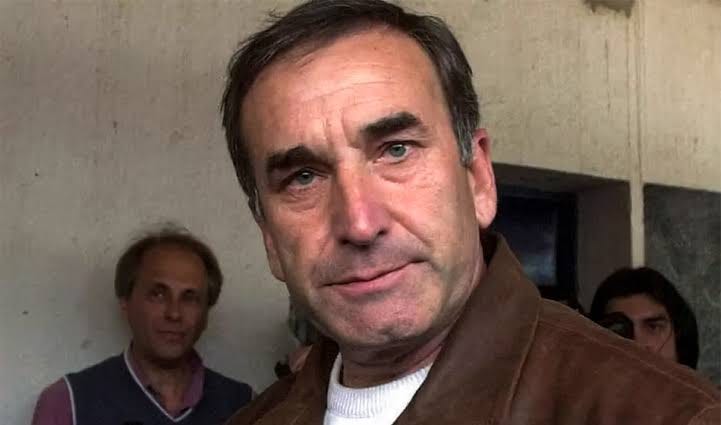
Argentinian Football has long had a bad reputation with English supporters. Antonio Rattin symbolizes that aspect of Argentinian football.
Back in 1966, Rattín prompted Sir Alf to refer to the Argentinian team as animals. Another claim to fame for Rattín was that he inspired English referee Ken Aston to invent the red and yellow card system which came into operation in 1970 and was still around 56 years later to bite another Argentinian, Enzo Fernandez, in his hairy tattooed arse.
When he was booked in the 35th minute after a nasty challenge on England’s Roger Hunt, Rattín complained to the German referee Rudolf Kreitlein that he did not speak German and could not understand him. Kreitlein, who could not speak Spanish, lost patience with Rattin and sent him off for “violence of the tongue”. After several minutes’ delay, he eventually made his way off the field, only to crumple an England corner flag and sit on a red carpet reserved for Queen Elizabeth II.
Rattín was 6’3’ and his imposing physical presence earned him the nickname “El Caudillo” (The Chief), and he was a dominant defensive force in the midfield. Rattín spent his entire professional club career (1956–1970) with Boca Juniors, making 382 appearances, winning four league titles, and captaining them through a golden era.
After football, he went into politics, serving as a national deputy between 2001 and 2005. You might guess which side he supported. Antonio Rattín represented the conservative, right-wing Federalist Unity Party (Partido Unidad Federalista, commonly abbreviated as PAUFE). He was personally recruited by the party’s leader, former police sub-inspector Luis Patti. Patti’s political career was ultimately overshadowed and destroyed by his actions during Argentina’s “Dirty War” military dictatorship (1976–1983). Patti was later convicted of crimes against humanity—including kidnapping, torture, and murder—committed during the 1976–1983 military dictatorship.
Ossie and Ricky
However, England took two Argentinian players to their hearts. Ricky Villa and Ossy Ardiles were both key pillars of the 1978 Argentina World Cup-winning side. Immediately after the World Cup, they were both signed by Tottenham Hotspur, breaking a decades-old English restriction on foreign players. They became house-trained cuddly domestic pets. Good animals, unlike Rattin.
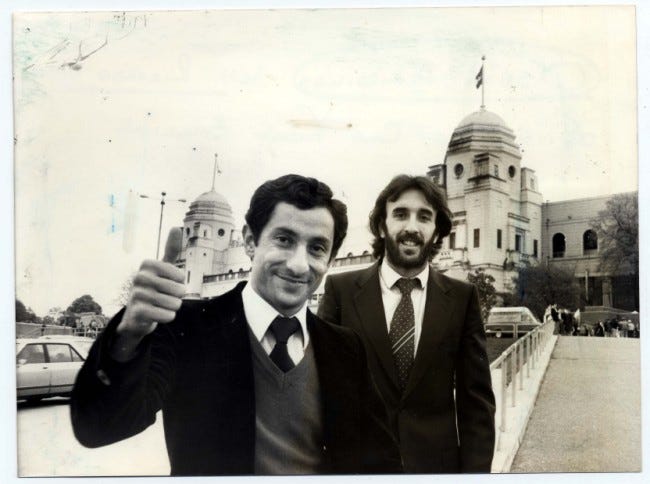
Villa is immortalised for scoring a magnificent solo winning goal in the 1981 FA Cup Final replay against Manchester City, slicing through the entire defence. It was voted the Wembley “Goal of the Century”. I remember it well. I was a City supporter in those days and had a house party for the final where I consumed much alcohol in company with Paddy McGinley and other reprobates. No-one was expecting a replay least of all another City supporter of my acquaintance who had already arranged his wedding for the replay date. We missed the match and I found myself staying the night in Brixton when the riots broke out.
Ricky also went into politics when his football career was over. Unlike Rattin, he joined the virtuous side. He drew parallels between the corrupting nature of political systems and the corporate business side of modern football. Though he left official party politics behind, he has occasionally engaged in political remembrance. In 2008, he participated in “La Otra Final” (The Other Final)—a match organized to honour the victims and “disappeared” citizens of the brutal military dictatorship that ruled Argentina during their 1978 World Cup victory.
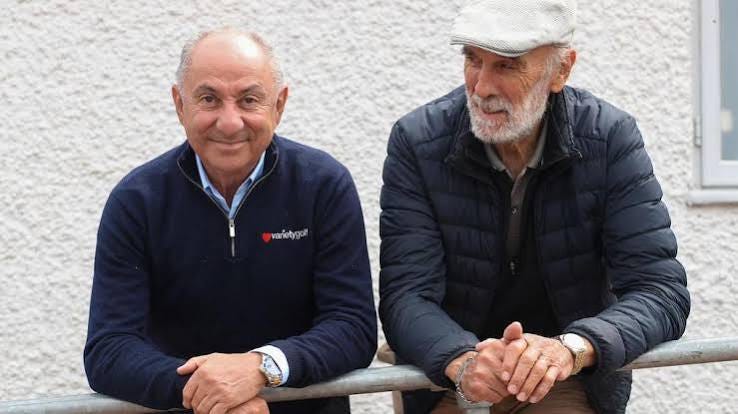
Alongside Villa, Ardiles became an icon at White Hart Lane. When the Falklands War broke out in 1982, Spurs fans unfurled a banner reading: “Argentina can keep the Falklands, we’ll keep Ossie”. 1982 Falklands War left him personally devastated, when his cousin was killed in action while serving in the Argentinian Air Force. Ardiles acknowledged that the regime of General Jorge Videla exploited the national team’s tournament victory as political distraction from the “Dirty War. After retiring, he stayed in the UK to manage clubs like Swindon Town, West Brom, and Newcastle. He eventually returned to Spurs as their first Argentinian Premier League manager, implementing an ultra-offensive formation using five forwards.
Don’t Cry for Me
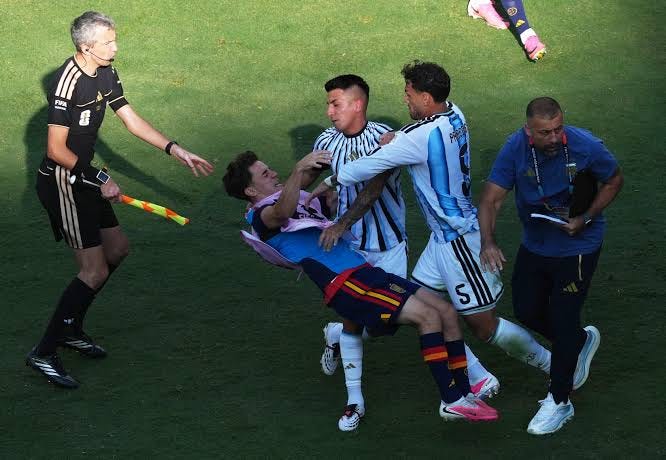
The Argentininan team behaved abysmally during and after the 2026 World Cup final. They were completely outplayed by Spain without a single shot on target. Full back Nahuel Molina started the brawl by punching Spain’s captain, Rodri, in the stomach as Rodri ran onto the pitch to celebrate.
Assistant coach Roberto Ayala is being investigated for putting his hand around Eric García’s throat and striking midfielder Dani Olmo.
One of the key figures in the post-match assault by the Argentinian players was Leandro Paredes. I spotted him early in the game and thought him lucky to escape a red card. The 32-year-old midfielder is renowned for his exceptional passing range, positional discipline, and tough-tackling style. Yep. Paredes is of Paraguayan descent and speaks fluent Guaraní. He is married to his childhood sweetheart, Camila Galante. The couple met when Paredes was just eight years old. At age 14, he was so certain they would be together forever that he had her name tattooed on his body; they later married in 2017 and have two children. That’s nice.
Throughout his career, Paredes has frequently been involved in high-stakes altercations and disciplinary trouble. During the 2022 World Cup quarterfinal against the Netherlands, after committing a hard, sliding foul on Dutch defender Nathan Aké, Paredes immediately got up and deliberately smashed the ball at maximum force directly into the Netherlands’ substitute bench. This prompted a pitch invasion and an on-field brawl. After the 2026 final, he allegedly shoved Eric García to the floor, grabbed him by the throat, and later threw Gavi to the turf. In his first public statement following the tournament, Paredes expressed immense pride in his team but conspicuously refused to apologize for the violent physical altercations. He is already back in training with Boca Juniors.
If found guilty of direct violent conduct, the implicated players face a minimum three-match competitive international ban, which could be heavily extended if classified as aggravated assault. The Argentinian Football Association (AFA) faces substantial financial penalties and possible stadium closures for future qualifiers.
In an editorial addressed to the players, Silvia Fesquet, editor of Buenos Aires newspaper Clarín, wrote that the squad displayed a “range of values that are hard to find these days,” emphasising that they did not speak ill of their rivals or try to deflect blame for their mistakes. Under the front-page headline, “They gave it their all: there is nothing to blame them for,” the publication asserted that a deep, historic bond had been forged between the public and the team regardless of the result.

Messi the Messer
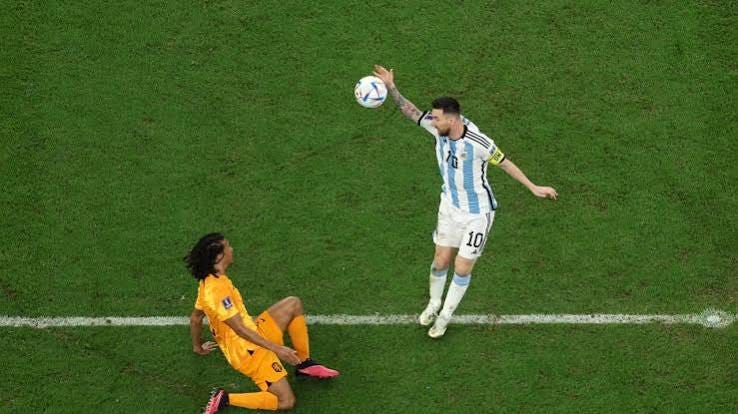
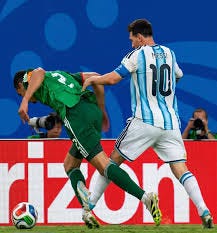
I had deluded myself that Lionel Messi had comported himself with some dignity amongst all this savagery. Wayne Rooney pointed out that Messi was, coldly and calculatingly, working on the referee to get Marc Cucurella Saseta sent off. There are countless YouTube shorts showing Messi getting in little niggles around the opponent’s ankles, pulling and tugging, mouthing off to the ref.
After the final, he may have looked dignified sitting alone with his grief, but should he not, as captain, be controlling his players? Should he not have stopped them behaving like animals? Was he any better than Rattin?
Excellent piece that kept me reading all the way through.