
Abdullah Ibrahim RIP
Abdullah Ibrahim (formerly known as Dollar Brand) died at the age of 91 on June 15 2026 at a hospital in Prien am Chiemsee, Upper Bavaria, Germany.

Abdullah Ibrahim
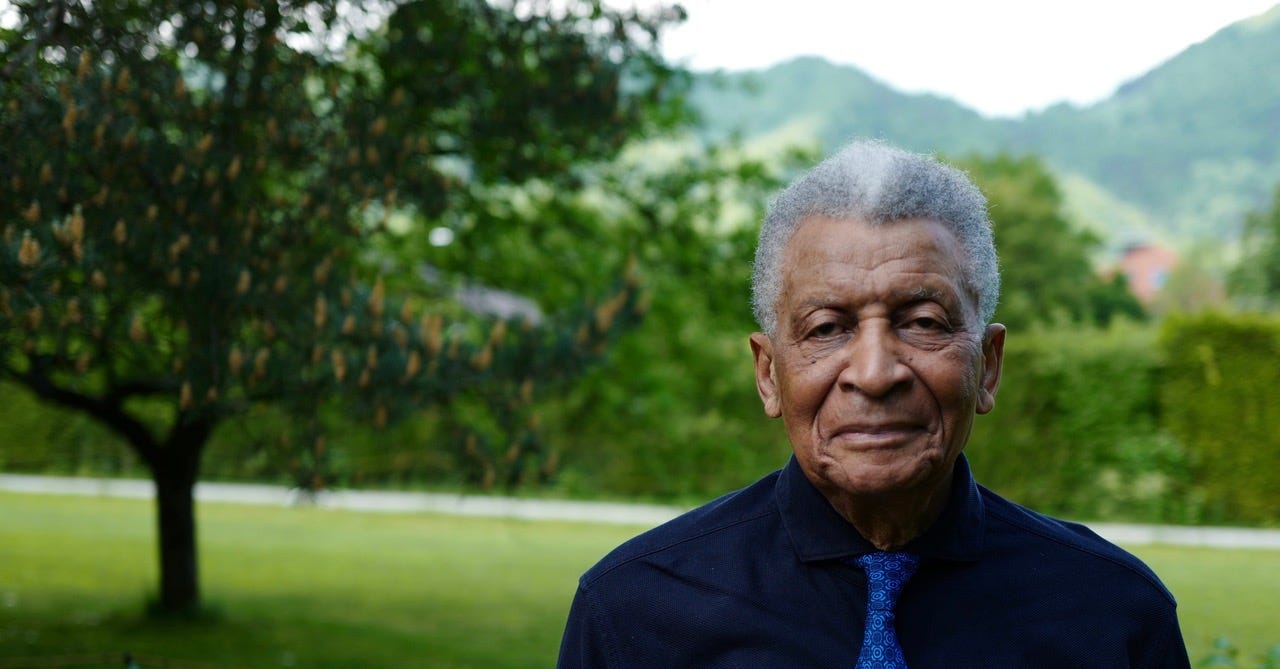
Following the formation of his band Ekaya in the 1980s, Ibrahim became mostly based out of Germany for recording and touring. His partner, Dr Marina Umari, issued the official statement on behalf of the family, saying that he “passed away peacefully with South Africa and its people in his heart”.
I was fortunate to see Abdullah Ibrahim perform live on several occasions. I saw him in the early days of the Jazz Café, in June 1991. That performance featured his Ekaya line-up which had Carlos Ward on alto sax and flute. I only just discovered that Ward died in January this year. I recently acquired a recording of Ward with John Coltrane. AB Spellman wrote: “This was the first time I’d heard Panamanian altoist Ward. He seemed to be neither a screamer nor a singer, but a talker. He seemed to be engaged in some kind of a dialog with himself, playing a rapid series of terse, self-contained, but related phrases. I liked Ward; his ear is different. I couldn’t sort out his influences in this cauldron, however, and I look forward to hearing him in a smaller group.” I loved Ward’s sound. He made a dozen albums with Abdullah Ibrahim and also worked with Don Cherry, David Murray and Cecil Taylor.
I was familiar with Ekaya’s work from CDs. Melodies like “The Wedding” from 1978 and “Water From an Ancient Well” from 1986 still play in my head. “Mannenberg” featuring tenor player Basil Coetzee became a liberation anthem for anti-Apartheid activists.
Graham Lock noted “Mannenberg was actually recorded during a break in a studio session when Ibrahim began playing around on an old upright piano whose honky tonk sound he liked. When no record company wanted to release that particular tape, Ibrahim made some acetates himself and played the disk in a little record shop near the Johannesburg bus terminal. Within a week, he’d sold 5000 copies over the counter and the LP, whose appearance had coincided with the 1976 uprisings, became synonymous with the freedom struggle.”
Blackheath
I saw Abdullah Ibrahim in a more austere mood in autumn 1994 (I cannot provide a precise date as Google AI is confessing to hallucinations) at Blackheath Concert Halls. This was a solo piano performance consisting of one single uninterrupted piece made up of compositions from throughout his career, plus themes by influencers such as Ellington and Monk. The concert took place just months after South Africa had held its first fully democratic election. Ibrahim had returned from decades of political exile to perform at Nelson Mandela’s presidential inauguration. Nelson Mandela once called him “our Mozart.” On that night, Ibrahim walked onto the stage at Blackheath Concert Halls, sat at the piano without saying a word, and began playing a quiet, low-register drone, with sombre left-hand rumbles. One song faded into the next without pause, creating a meditative, cyclical journey that only concluded when he finally lifted his hands from the keys at the very end of the set.
A 21-year-old Nikki Yeoh provided a solo support performance on that drew widespread praise from London jazz critics and solidified her reputation as one of the most exciting new contemporary piano talents in the country.
Barbican
I saw him again when he was 88 at the Barbican Centre on Saturday 15 July 2023, with a drumless trio format- Cleave Guyton on flute, piccolo, saxophone and Noah Jackson on bass, cello. Reviewers noted that in London Ibrahim is always received rapturously and accorded a reverence reserved for few jazz musicians. He had been unhappy actually living in London, which he remembered as a time of too little work (‘I think we got three gigs in six months, two pounds ten shillings a time!’) and too much drink (‘Oh, man, that was a foggy time. The fog was inside my head, right? I had a problem then, too much liquid!’).
The concert opened with interpretations of Duke Ellington’s ‘In a Sentimental Mood’ and John Coltrane’s ‘Giant Steps’. Kevin Le Gendre wrote of the concert in JazzWise “it is Ibrahim’s originals that take pride of place, showing how, since the ‘60s, he has been creating standards of his own that vividly capture the poised dignity of African culture and customs.“
The performance was issued on two CDs by Gearbox records. CD1 was recorded in the afternoon without an audience. CD 2 was recorded in the evening with me in attendance. If you try hard enough you can hear me clapping. This is what they played in my presence:
In a Sentimental Mood (Duke Ellington cover)
8Giant Steps (John Coltrane cover)
Reprise 1
Water from an Ancient Well
Nisa
The Wedding
Tuang Guru
Reprise 2
15. Dreamtime
Skippy (Thelonious Monk cover)
Blue Bolero
Mindif
Trance-mission (Concludes with an intimate, raw vocal solo by Ibrahim)
Biography
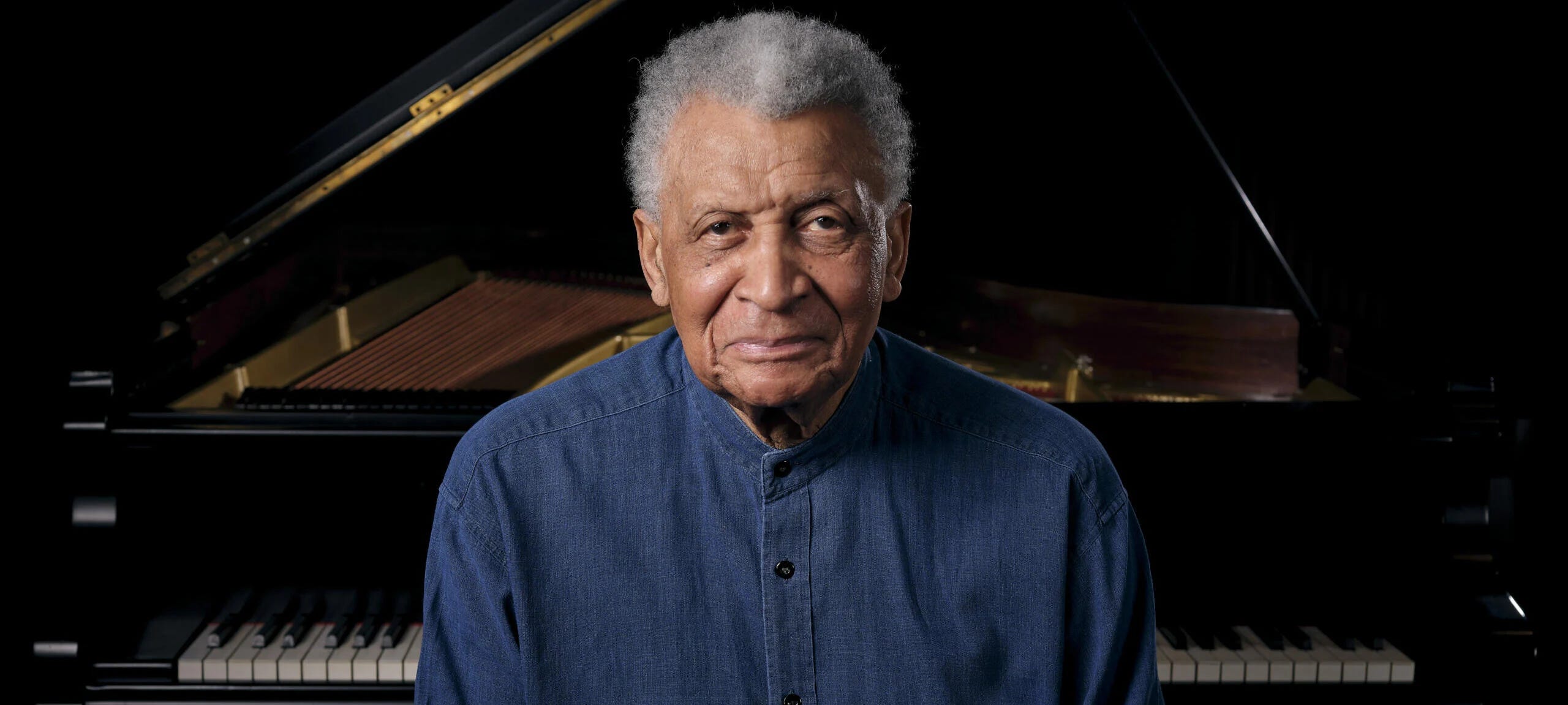
In 1960, Bessie Head wrote of the 26-year-old Dollar Brand “a powerful, vitally alive and creative man” who stood out like “a complete and perfect flower in this desert”: “He hurls a challenge at you; disturbs you; teaches and expects perfection from you.”
Abdullah Ibrahim was born Adolf Johannes Brand in 1934 and grew up in Kensington, a working-class neighborhood on the northern edge of Cape Town’s inner city inhabited largely by “coloureds”. These were descendants of enslaved people from Southeast Africa and the Indian Ocean; people born of mixed relationships between whites and blacks; aboriginal peoples like the Khoi, San, and Griqua; and anyone that the racist regimes could not fit into their toxic taxonomy. Ibrahim’s music is of a mongrel nature drawing from a strong genetic pool. Ibrahim’s work carries the echoes of church hymns, Islamic devotional chants, and township dance rhythms: goema, marabi, kwela.
He made his professional debut at the age of fifteen playing and later recording with the Tuxedo Slickers, big band in Cape Town. He also played piano with the local Cape Town dance bands, vocal groups and saxophone with the Minstrel Carnival.
In 1958 he created his own “Dollar Brand Trio” showcasing his original compositions as well as those of Jazz Masters. He formed the Jazz Epistles, formed in 1959 in Johannesburg with co-leader: Kippie Moeketsi, the brilliant classically trained clarinetist and jazz saxophone player as well as Hugh Masekela (trumpet), Jonas Gwangwa (trombone), Johnny Gertze (bass), and Makaya Ntshoko (drums).
Graham Lock interviewed Abdullah Ibrahim for The Wire in 1983 and got the impression of “a man of great dignity, authority and charm.”
https://leguesswho.com/news/lgw22-abdullah-ibrahim-interview
He told Lock, “If you become a commercial success in South Africa, they’re going to try and use you, make you pay homage to the system. The moment you become visible, you have no choice. The system drives you into the arms of the revolution: either that or you stop playing. You leave the country or you stop playing. There’s no other way to deal with it.”
Ibrahim found refuge in Switzerland, taking up a three-year contract at Zurich’s Club Africana. It was there that he met several visiting American jazz musicians, including Max Roach, John Coltrane, Abbey Lincoln and the Duke. As the legend goes, it was Ibrahim’s then wife Bea Benjamin who persuaded Ellington to listen to the Dollar Brand Trio at the Africana, which led to the now famous ‘Duke Ellington presents the Dollar Brand Trio’ recording. Under Ellington’s patronage he recorded for Frank Sinatra’s Reprise label. Ellington invited him to perform with his band and convinced the promoter George Wein to include him in the programme of the 1965 Newport jazz festival. He moved to New York City in 1965 and befriended the likes of Coltrane, Don Cherry and Ornette Coleman.
He recorded with the Munich Symphony Orchestra (African Symphony, 2001) and the orchestras of the German radio stations NDR in Hamburg and WDR in Cologne. He composed the soundtracks for films by the French director Claire Denis (Chocolat, 1988, and S’en Fout la Mort, 1990), and one by the Burkino Faso director Idrissa Ouédraogo (Tilaï, 1990).
https://www.nybooks.com/online/2026/06/07/songs-of-liberation-abdullah-ibrahim/
https://www.theguardian.com/music/2026/jun/16/abdullah-ibrahim-obituary
Thanks so much for this. I came to his music just recently, after reading an obituary.
One by one, the greats depart, leaving voids which cannot be filled.